

3 Way Ball Valves
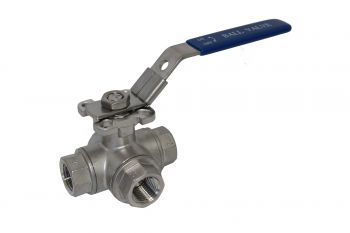
Stainless steel 3-way ball valves are designed to divert, distribute, or combine flow between three piping connections. Rather than simply opening or closing flow, a 3-way ball valve can redirect fluid between multiple ports within the same valve body. The available flow paths depend on the internal port configuration and handle position.
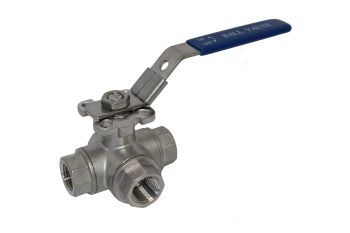
We stock both T-Port and L-Port 3-way ball valves for industrial process systems, fluid transfer applications, water treatment equipment, and other installations requiring flexible flow routing. All models feature threaded connections, a three-port body design, a 1000 WOG pressure rating, and an ISO mounting pad for actuator installation.
 View All Stainless Steel Ball Valves, including 1-piece, 2-piece, 3-piece, and 3-way ball valve configurations.
3 Way Ball Valve Configurations
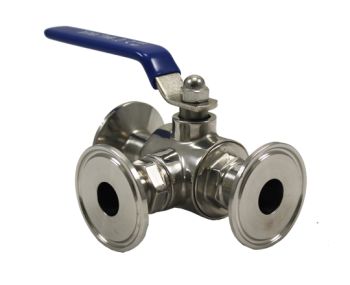
- T-Port 3 Way Ball Valves – used for mixing, combining, splitting, or distributing flow between multiple process lines.
- L-Port 3 Way Ball Valves – used for diverting flow between different piping routes or selecting between fluid sources.
What are Three-Way Ball Valves?
A three-way ball valve is a multi-port valve designed with three ports. A regular two-way valve only has two ports. It consists of a main central body that houses the internal parts and three end connections that contain the ports. It gets its name from this three-port design, which enables fluid to travel along three possible pathways. A three-way valve allows the flow to be directed between the three ports, whereas a regular two-way valve only allows flow along a single path. Like all ball valves, it has an internal ball with an opening; however, instead of having a straight channel through the valve, it has an opening shaped into a pattern to match up with some or all of the three ports, depending on how the handle is turned. This makes it possible to choose between a few different routing options in one valve body. They can be used to combine or to split the flow of fluids, or they can be used to divert the flow from one path to another
T-Port vs L-Port 3-Way Ball Valves
Three-way valves are made in two styles, depending on the shape of the passage inside the ball. These two styles are called T-Port and L-Port, and they are named after the shape of the bore or passage that runs through the ball. Each one of these designs directs the flow routing in a different pattern.
T-Port (Used for Mixing or Splitting)
A T-Port valve has a ball with an internal passage in the shape of a ‘T’, enabling it to align with all three ports at once. This allows you to either mix two flows into one line or to split one line into two. The T-shaped passage can also be used to align with only two ports at a time, effectively closing the flow in the third port. This allows you to divert flow, selecting between flow paths much like an L-Port valve.
- Shape: ‘T’ pattern
- Flow path: flow can align with all three ports at once or any two ports.
- Function: Used to mix or split the flow, can also be used for diverting, but cannot stop all flow.
L-Port (Used for Selecting or Diverting)
A L-Port valve has a ball with an internal passage in the shape of an ‘L’, enabling it to align with only two ports at a 90-degree angle. This allows you to divert flow from one port to another, or to select input from one of two sources. They can also be used to shut off all flow.
- Shape: A L-Port valve has a ball with a bore in the shape of an ‘L.’
- Flow path: flow can align with only two ports at once at a 90-degree angle.
- Function: Used for selecting or diverting the flow and can also stop all flow.
| Feature | T-Port | L-Port |
|---|---|---|
| Main Purpose | Mixing or splitting flow | Diverting flow |
| Connect All 3 Ports | Yes | No |
| Mixing Capability | Yes | No |
| Can Shut Off Flow | No | Yes |
| Common Applications | Mixing and distribution | Flow selection and diversion |
➤ For a detailed comparison of flow paths, valve positions, and application differences, see our L-Port vs T-Port Ball Valve Guide.
How does a 3-way ball valve work?
A 3-way ball valve works by rotating a ball with a specially shaped internal passage (bore). The internal ball is rotated using the handle or by using an actuator. The internal passage is in the shape of an “L” or a “T”, and when the ball is rotated, this “L” or “T” shaped passage aligns with specific ports on the valve, and either diverts, mixes, or shuts off the flow between three lines.
➤ Learn more about valve bodies, stems, seats, seals, and internal ball designs in our Ball Valve Parts and Components guide.
Mechanism:
- Rotation: A handle (or actuator) turns a stem, which rotates the internal ball typically in 90-degree (quarter-turn) increments.
- Alignment: As the ball rotates, its internal bore aligns with different port combinations to create specific flow paths.
Flow Configurations
The specific function depends on whether the internal bore is drilled in an L or T shape.
L-Port (Diverter Type):
- Function: Used to divert flow from a source to one of two outlets.
- Positions: Can connect two ports at a 90-degree angle. (No straight-through flow path).
- Shut-off: They can completely shut off the flow.
T-Port (Mixing or Distributing Type):
- Function: Used for mixing two flows into one or splitting a single flow into two.
- Positions: Can connect all three ports at once, or it can connect any two ports. (Can provide a straight-through flow path.)
- Shut-off: They cannot fully shut off all flow.
Frequently Asked Questions About 3 Way Ball Valves
What is a 3 way ball valve?
A 3 way ball valve is a multi-port valve with three connections that allows flow to be diverted, distributed, mixed, or selected between different piping paths. The flow pattern depends on the internal port design and handle position.
What is the difference between a T-Port and L-Port ball valve?
A T-Port ball valve can connect all three ports and is commonly used for mixing, splitting, or distributing flow. An L-Port ball valve connects two ports at a time and is typically used for diverting flow or selecting between fluid sources.
Can a 3 way ball valve shut off flow?
L-Port 3 way ball valves can be configured to completely stop flow. T-Port valves are primarily designed for flow diversion, mixing, or distribution and generally cannot shut off all flow paths simultaneously.
What are 3 way ball valves used for?
3 way ball valves are used in industrial process systems, water treatment, chemical handling, manufacturing, fluid transfer, and other applications where flow must be directed between multiple lines.
Can a 3 way ball valve mix fluids?
Yes. T-Port 3 way ball valves can be used to combine two incoming flow streams into a single outlet, making them suitable for mixing and blending applications.
Are 3 way ball valves full port?
Many stainless steel 3 way ball valves are manufactured with a full port design to minimize pressure loss and maintain flow efficiency. Port configuration may vary by model and should be verified from the product specifications.
What end connection types are available for 3 way ball valves?
3 way ball valves are commonly available with threaded end connections for industrial systems and sanitary tri-clamp connections for hygienic processing applications. They are also available with socket weld and flanged end connections for specialized industrial applications.
Related Ball Valve Resources
➤ L-Port vs T-Port Ball Valve
Compare flow paths, mixing capabilities, diverting functions, and common applications of T-Port and L-Port 3 way ball valves.
➤ Ball Valve Applications
Learn how stainless steel ball valves are used in water treatment, industrial processing, chemical handling, and fluid transfer systems.
➤ Ball Valve Pressure Ratings Explained
Understand WOG ratings, PSI ratings, pressure-temperature relationships, and pressure derating.
➤ Full Port Ball Valve vs Standard Port
Compare bore size, pressure drop, flow restriction, and common industrial applications.
