

Understanding the Difference Between L Port and T Port Ball Valves
L Port vs T Port Ball Valve
Industrial 3-way ball valves use different internal port configurations to control how fluid moves between connected pipeline paths. The two most common designs are L port and T port ball valves, each using a different internal bore shape to redirect, combine, or isolate flow within the valve body.
Understanding the difference between an L port vs T port ball valve is important when selecting a valve for directional flow control, mixing service, bypass routing, or process-line distribution. These valve styles are commonly used in stainless steel ball valves where the valve must do more than simply open or close a straight pipeline.
L Port vs T Port Ball Valve Comparison Chart
| Comparison Point | L Port Ball Valve | T Port Ball Valve |
|---|---|---|
| Internal Bore Layout | Uses a 90-degree internal passage for directional switching | Uses a cross-style bore that can support several routing positions |
| Flow Behavior | Moves flow from a common line toward one selected branch | Can allow shared flow, combined flow, or divided flow between ports |
| Typical System Role | Used where the operator needs to choose between alternate outlet paths | Used where the system may need blending, recirculation, or branch distribution |
| Port Interaction | Commonly leaves one side port closed while two ports communicate | May allow communication between two or all three ports based on valve position |
| Best Application Fit | Directional transfer, tank selection, and basic diverting layouts | Mixing, bypass circulation, shared branch flow, and multi-line routing |
What is a 3-Way Ball Valve?
A 3-way ball valve has three connection ports arranged around a rotating ball. Instead of only opening or closing a single straight-through line, the internal bore lets the valve route fluid between different pipe connections as the handle position changes.
For a broader overview of valve operation and ball valve types, see our What is a Ball Valve? guide.
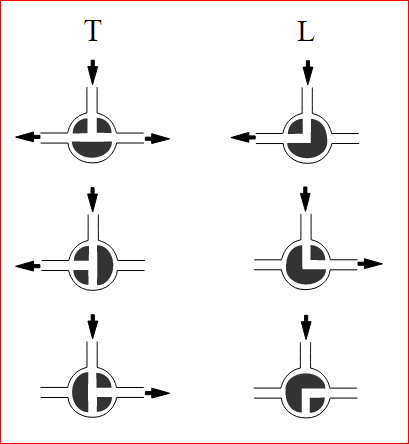
The internal ball may be machined with an L-shaped or T-shaped flow passage. That machined passage determines whether the valve works mainly as a directional selector, a mixing valve, a bypass valve, or a distribution point within the piping system.
➤ View 3-way stainless steel ball valves for industrial systems that require diverting, mixing, or multi-directional flow control.
What is an L Port Ball Valve?
An L port ball valve uses a drilled internal bore that forms a 90-degree flow path inside the ball. As the handle rotates, the valve redirects fluid from a common port toward one of two connected outlet lines.
This configuration is primarily used for directional flow switching rather than simultaneous multi-port flow. In most operating positions, one flow path remains open while the third valve port stays isolated.
L port designs are commonly installed in industrial systems that alternate flow between tanks, filters, transfer lines, or parallel process equipment.
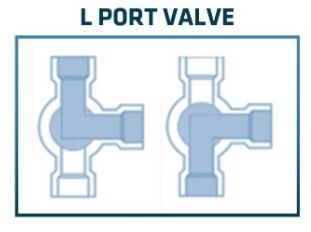
Typical L Port Ball Valve Functions
- Redirecting flow from one supply line toward one selected outlet
- Alternating between two tanks, filters, or treatment paths
- Changing flow direction without adding multiple inline valves
- Keeping one branch isolated while another branch remains active
What is a T Port Ball Valve?
A T port ball valve uses a cross-drilled internal bore that allows several possible flow arrangements depending on valve orientation and handle position. Unlike an L port design, a T port valve can maintain communication between multiple ports simultaneously.
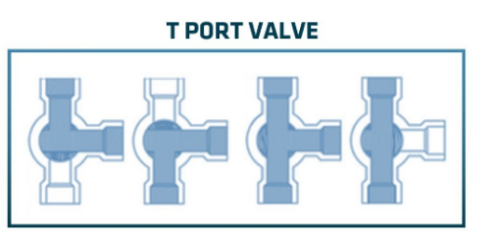
This makes T port valves useful for blending, recirculation, bypass routing, and process distribution systems where fluid may need to be combined or shared between multiple connected lines.
Some T port configurations also allow straight-through flow while simultaneously feeding a secondary outlet connection.
Typical T Port Ball Valve Functions
- Combining two compatible fluid streams before discharge
- Sending one inlet stream toward more than one connected branch
- Maintaining recirculation or bypass flow through selected lines
- Creating shared flow paths in multi-line process equipment
Main Difference Between L Port and T Port Ball Valves
The key difference between L port and T port ball valves is how the internal bore connects the valve ports during rotation. L port valves primarily redirect flow between separate outlet paths, while T port valves provide broader multi-port routing capability.
In industrial systems, L port valves are commonly selected for directional transfer applications, while T port valves are more often used where blending, bypass flow, recirculation, or simultaneous port communication is required.
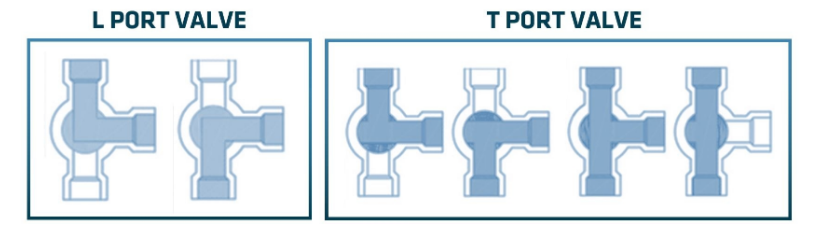
Diverting vs Mixing Ball Valves
Diverting service and mixing service require different internal flow arrangements inside a 3-way ball valve. L port valves are typically used for diverting because they route one inlet toward different outlet paths without normally connecting all ports simultaneously.
T port valves are more commonly used for mixing or distribution because the internal T-shaped bore can maintain communication between several connected lines at the same time. This allows fluid streams to merge, split, or circulate through multiple branches of a piping system.
Handle Positions and Flow Direction
Handle position controls how the machined passage inside the ball lines up with the valve ports. When the handle is turned, the internal bore rotates with the ball and changes which pipe connections are open to each other.
On an L port valve, this movement usually changes the active outlet path. On a T port valve, the same handle movement can create more than one flow arrangement, including straight-through flow, branch flow, bypass flow, or three-port communication.
Common Industrial Applications
Common L Port Ball Valve Applications
- Alternating discharge between two tanks
- Selecting between filtration or treatment lines
- Routing water, oil, air, or compatible process fluids to a selected branch
- Changing flow direction in compact piping assemblies
- Simple bypass lines where one path is used at a time
Common T Port Ball Valve Applications
- Combining two compatible inlet streams
- Dividing one flow path between multiple outlets
- Maintaining circulation in bypass loops
- Distributing flow across connected process lines
- Supporting blending, recirculation, or multi-branch operation
How Port Design Relates to Ball Valve Selection
On a 3-way valve, port geometry controls where fluid can travel as the handle rotates. That makes the internal port layout more important than simple open-or-closed operation.
This is different from many two-way ball valves, where full port, standard port, and reduced port terminology mainly describes bore size and pressure loss. For more detail on bore size and flow restriction, see our guide to Full Port Ball Valve vs Standard Port.
3-Way Valve Construction and Serviceability
Many industrial 3-way ball valves use multi-piece body construction similar to other threaded stainless steel ball valve designs. The body style can affect how easily the valve can be inspected, cleaned, or serviced after installation.
For more detail on body construction and maintenance access, see our guide to 2 piece vs 3 piece ball valves.
L Port vs T Port: Which Should You Choose?
Choose an L Port Ball Valve If:
- The system needs to send flow to one outlet path at a time.
- You are switching between tanks, filters, pumps, or treatment equipment.
- The third valve port should normally stay isolated during operation.
- The application needs straightforward directional transfer.
Choose a T Port Ball Valve If:
- The system needs to combine or divide flow between connected lines.
- Bypass, recirculation, or shared branch flow is part of the process.
- More than two ports may need to remain connected in selected positions.
- The application needs flexible multi-port routing instead of simple diversion.
For broader valve selection options, browse our complete range of stainless steel ball valves.
Frequently Asked Questions
How are L port and T port ball valves different?
An L port valve usually works as a directional selector, moving flow from one common line into one chosen outlet path. A T port valve gives the piping layout more options because it can support combined flow, divided flow, or shared communication between several ports.
When should an L port ball valve be used?
Use an L port valve when the system needs to choose between two separate flow destinations. Common examples include tank selection, filter switching, transfer-line routing, and equipment bypass layouts where one branch operates at a time.
When should a T port ball valve be used?
Use a T port valve when the piping system needs shared flow between multiple connections. It is commonly selected for blending, circulation, branch distribution, or applications where one flow path may need to feed more than one line.
Can a T port ball valve be used for diverting flow?
Yes. A T port ball valve can be configured for diverting flow, but it is generally selected when the application may also require mixing, bypass routing, recirculation, or communication between multiple ports. An L port valve is often the simpler choice when only basic diversion is required.
Is an L port valve better for diverting?
Yes. An L port valve is usually the cleaner choice for basic diverting because its internal passage naturally sends flow from a common port toward one selected outlet while closing off the unused path.
Is a T port valve better for mixing?
Yes. A T port valve is generally better when fluid streams need to come together or separate across multiple branches. The cross-style bore can keep more than one port open depending on handle position and valve layout.
Are L port and T port valves both used in 3-way ball valves?
Yes. L port and T port refer to the internal flow pattern used inside 3-way ball valves. The correct choice depends on whether the piping system needs simple diversion, flow sharing, mixing, bypass routing, or multi-line distribution.
Related Ball Valve Resources
➤ What is a Ball Valve?
Learn how ball valves work, how quarter-turn shut-off valves operate, common valve types, and typical industrial applications.
➤ Ball Valve Applications
Learn how stainless steel ball valves are used in water systems, oil and gas piping, chemical processing, compressed air systems, food processing, hydraulic systems, and industrial fluid control.
➤ Ball Valve Parts and Components
Understand valve bodies, PTFE seats, seals, stems, handles, threaded end connections, and other internal ball valve components.
➤ Ball Valve Repair and Maintenance
Learn how PTFE seats, seals, stem packing, and serviceable valve components affect repair and maintenance decisions.
➤ 304 vs 316 Stainless Steel Ball Valves
Compare corrosion resistance, chemical compatibility, marine performance, and how stainless steel grade affects valve selection.
➤ Full Port Ball Valve vs Standard Port
Understand how full port, standard port, and reduced port designs affect flow restriction and pressure loss.
➤ 2 Piece vs 3 Piece Ball Valve
Learn how valve body construction affects maintenance access, serviceability, and industrial valve selection.
➤ View 3-Way Ball Valves
Compare stainless steel 3-way ball valves for diverting, mixing, bypass, and multi-directional flow-control systems.
Shop Stainless Steel Ball Valves
➤ Browse Stainless Steel Ball Valves
View stainless steel ball valves for industrial fluid handling, shut-off, diverting, and multi-directional flow-control applications.
➤ View 3-Way Ball Valves
Compare 3-way stainless steel ball valves for diverting, mixing, bypass, and multi-port industrial flow-control systems.
➤ Shop 2 Piece Full Port Ball Valves
Compare full port threaded ball valves commonly used in industrial piping, process systems, and fluid transfer applications.
