

Understanding Ball Valve Parts, Components, Seats, Stems, Bodies, and Seals
Ball Valve Parts and Components
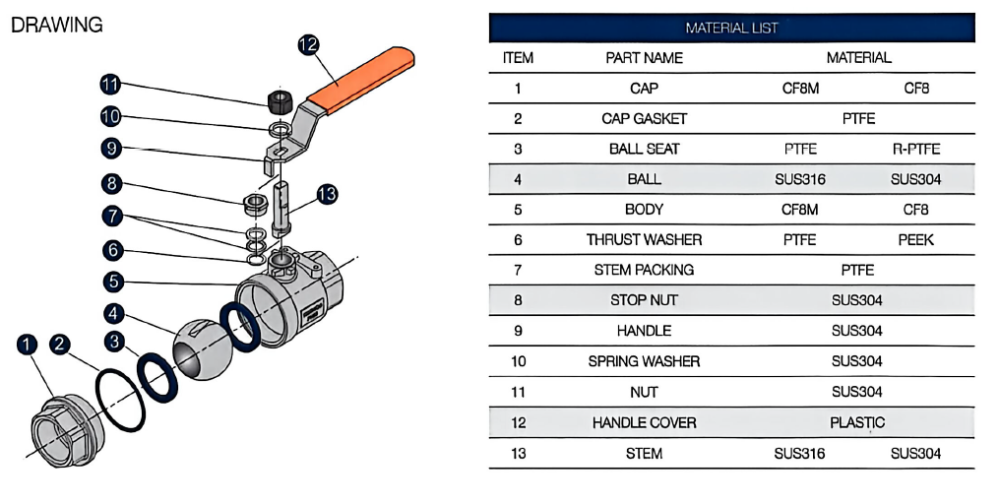
Ball valve parts work together to provide fast quarter-turn shut-off in industrial piping systems. Although the outside of a valve may look simple, the internal components determine how the valve seals, rotates, handles pressure, resists corrosion, and performs over time.
Understanding the main ball valve components helps maintenance teams, equipment buyers, and industrial users choose the correct stainless steel ball valves for threaded piping, pressure-rated service, repair access, and long-term reliability. For a broader overview of valve operation, see our what is a ball valve guide.
Main Ball Valve Parts Overview
| Ball Valve Part | Function | Why It Matters |
|---|---|---|
| Valve Body | Houses the internal ball, seats, stem, and seals | Controls strength, corrosion resistance, connection type, and serviceability |
| Ball | Rotates to open or block the flow path | Determines shut-off action and flow opening through the valve |
| PTFE Seats | Support and seal against the ball | Critical for leak resistance and smooth quarter-turn operation |
| Stem | Connects the handle to the internal ball | Transfers handle movement into ball rotation |
| Stem Packing and Seals | Seal around the rotating stem | Helps prevent external leakage near the handle |
| Handle | Provides manual quarter-turn operation | Shows open or closed position and allows quick shut-off |
| Threaded Ends | Connect the valve to NPT piping | Allows installation without welding or flanges |
Valve Body
The valve body is the main pressure-containing structure of a ball valve. It holds the internal ball, seats, seals, stem, and end connections in alignment. In stainless steel ball valves, the body also provides corrosion resistance for industrial fluid-control environments.
Valve bodies may be manufactured as 1-piece, 2-piece, or 3-piece designs. A compact 1-piece body is often used where economy and simple shut-off matter most. A 2-piece body allows broader full-port options. A 3-piece body provides better access to internal parts for cleaning, inspection, and repair.
Different valve body designs are used across water treatment, chemical processing, manufacturing, food processing, compressed air systems, and general industrial fluid handling. Learn more in our Ball Valve Applications guide.
For a comparison of compact and serviceable body styles, including repairable 1-piece designs, see our guide to 1 piece vs 2 piece ball valves.
For a deeper construction comparison, see our guide to 2 piece vs 3 piece ball valves.
Internal Ball
The internal ball is the rotating component that opens or closes the valve. It contains a drilled bore through the center. When the bore lines up with the pipe, fluid can pass through. When the handle turns the ball 90 degrees, the solid side of the ball blocks the flow path.
The size of the bore through the ball affects flow performance. Full-port ball valves use a larger bore to reduce restriction, while standard port or reduced port valves use a smaller internal opening. For more detail on bore size and flow restriction, see our guide to Full Port Ball Valve vs Standard Port.
PTFE Ball Valve Seats
PTFE seats are among the most important sealing components inside many stainless steel ball valves. The seats sit on each side of the ball and create the contact surface that allows the valve to shut off flow when closed.
PTFE is commonly used because it provides low friction, chemical resistance, and a smooth sealing surface. This allows the ball to rotate with controlled operating torque while still maintaining tight shut-off performance in compatible industrial fluid applications.
When PTFE seats wear, compress, deform, or become damaged by debris, the valve may become harder to turn or may leak internally through the closed ball. For maintenance guidance, see our ball valve repair and maintenance guide.
Ball Valve Seals
Ball valve seals help prevent leakage between internal valve parts and around body joints. Depending on the valve design, seals may be used around the body connection, stem area, end connections, and seat interfaces.
In repairable valves, seals may be part of a maintenance kit along with seats, packing, thrust washers, or other wear parts. The correct seal material depends on the fluid, pressure, temperature, and chemical compatibility of the application. Material selection also affects long-term sealing performance in corrosive environments. For more information, see our guide to 304 vs 316 stainless steel ball valves.
Ball Valve Stem
The ball valve stem connects the external handle to the internal ball. When the handle is turned, the stem transfers that movement to the ball, rotating the bore into the open or closed position.
The stem must rotate smoothly while remaining sealed against internal pressure. Many industrial ball valves use a blowout-proof stem design, where the stem is assembled from inside the valve body to reduce the risk of pressure forcing it outward.
Stem Packing and Thrust Washers
Stem packing seals the area where the stem passes through the valve body. This is one of the most important areas for preventing external leakage near the handle.
Thrust washers help support stem movement and reduce friction during operation. If the stem packing wears or loses compression, the valve may begin to leak around the handle area. On serviceable valves, this area may be adjustable or repairable depending on the design.
Ball Valve Handle
The handle provides manual control of the valve. A standard ball valve handle rotates 90 degrees between open and closed positions. When the handle is in line with the pipe, the valve is usually open. When the handle is across the pipe, the valve is usually closed.
Industrial handles may include vinyl grips, lock plates, stop tabs, or locking devices. A locking handle can help secure the valve position during maintenance, storage, or controlled process operation.
Threaded End Connections
Threaded ball valve components include the end connections that attach the valve to the piping system. Most threaded stainless steel ball valves use female NPT threads, allowing the valve to connect directly to threaded pipe, fittings, equipment, pumps, or hose assemblies.
Threaded ends make installation and removal practical without welding or flanges. However, proper thread engagement, sealant selection, pipe alignment, and installation torque are still important for leak prevention and long-term performance. For installation guidance, see our how to install a threaded ball valve guide.
Common Ball Valve Wear Components
The most common wear parts in a ball valve are the soft sealing components. These parts experience movement, compression, chemical exposure, pressure, and contact with the internal ball.
| Wear Component | Common Issue | Possible Result |
|---|---|---|
| PTFE Seats | Wear, cuts, deformation, or debris damage | Internal leakage or poor shut-off |
| Stem Packing | Loss of compression or material wear | Leakage around the stem or handle |
| Body Seals | Compression set, chemical attack, or improper reassembly | Leakage at body joints |
| Thrust Washer | Wear from repeated stem movement | Increased operating torque or stem-area issues |
| Handle Hardware | Loose nut, bent handle, or damaged stop plate | Poor position control or difficult operation |
Repairable and Serviceable Ball Valve Components
Serviceable ball valves are designed so internal components can be accessed for inspection, cleaning, and replacement. This is especially important in systems where downtime is expensive, media can leave residue, or the valve may need periodic cleaning.
3-piece ball valves are commonly selected for this reason. The center body section can often be removed more easily than with compact 1-piece or 2-piece valve designs. This gives maintenance teams better access to the ball, seats, body seals, and internal cavity.
For maintenance-focused applications, view our 3 piece stainless steel ball valves.
How Ball Valve Parts Affect Pressure and Service Life
A valve’s pressure rating is not determined by the body alone. Seats, seals, packing, stem design, body construction, and end connections all affect whether a valve is appropriate for the service conditions.
Temperature also matters because soft sealing materials may have different pressure limits at elevated temperatures. A valve that works well at room temperature may require derating in heated service. For more detail, see our guide to ball valve pressure ratings.
Ball Valve Parts and Common Troubleshooting Clues
| Symptom | Component to Inspect | Likely Concern |
|---|---|---|
| Leak around handle | Stem packing and stem area | Packing wear or loss of compression |
| Leak through closed valve | Seats, ball, and internal bore | Seat wear, debris, or scratched ball surface |
| Handle difficult to turn | Seats, stem, packing, and ball surface | Debris, swelling, corrosion, or excessive packing compression |
| Leak at body joint | Body seal or gasket area | Seal damage, improper assembly, or body stress |
Frequently Asked Questions
What are the main parts of a ball valve?
The main parts of a ball valve include the valve body, internal ball, PTFE seats, stem, stem packing, seals, handle, and end connections. Serviceable valves may also include replaceable body seals, thrust washers, and repair components.
What do PTFE seats do in a ball valve?
PTFE seats support the ball and create the sealing surface inside the valve. They help the valve shut off flow while allowing the ball to rotate smoothly during quarter-turn operation.
What is the stem on a ball valve?
The stem is the component that connects the external handle to the internal ball. When the handle turns, the stem rotates the ball into the open or closed position.
Which ball valve parts usually wear out first?
The most common wear components are PTFE seats, stem packing, body seals, thrust washers, and handle hardware. Wear depends on pressure, temperature, media, cycle frequency, and valve design.
Are ball valve parts replaceable?
Some ball valve parts are replaceable, especially in serviceable 3-piece designs. Compact 1-piece valves are often replaced instead of rebuilt because internal access is limited.
What parts are typically included in a ball valve repair kit?
Many ball valve repair kits include replacement PTFE seats, stem packing, body seals, thrust washers, and related sealing components. Contents vary by valve design and manufacturer.
Why are 3-piece ball valves easier to service?
3-piece ball valves have a removable center section that provides better access to the ball, seats, seals, and internal cavity. This makes inspection, cleaning, and replacement of wear parts easier than with many compact valve designs.
Related Ball Valve Resources
➤ What is a Ball Valve?
Learn how ball valves work, how quarter-turn shut-off valves operate, common valve types, and typical industrial applications.
➤ Ball Valve Applications
Learn how stainless steel ball valves are used in water systems, oil and gas piping, chemical processing, compressed air systems, food processing, hydraulic systems, and industrial fluid control.
➤ Ball Valve Repair and Maintenance
Learn how PTFE seats, seals, stem packing, and serviceable valve components affect repair and maintenance decisions.
➤ How to Install a Threaded Ball Valve
Review NPT thread preparation, PTFE tape use, tightening methods, valve orientation, and leak testing for threaded ball valve installations.
➤ Ball Valve Pressure Ratings Explained
Learn how seats, seals, body construction, pressure, and temperature affect valve rating and service life.
➤ 304 vs 316 Stainless Steel Ball Valves
Compare corrosion resistance, chemical compatibility, marine performance, and how stainless steel grade affects valve selection.
➤ Full Port Ball Valve vs Standard Port
Understand how the internal ball bore affects flow restriction, pressure drop, and full-port vs reduced-port performance.
➤ 1 Piece vs 2 Piece Ball Valve
Compare compact one-piece valve construction with two-piece full-port designs, including serviceability, maintenance access, flow characteristics, and industrial applications.
➤ 2 Piece vs 3 Piece Ball Valve
Compare how valve body construction affects serviceability, maintenance access, cleaning, and long-term repairability.
Shop Stainless Steel Ball Valves
➤ Browse Stainless Steel Ball Valves
View stainless steel ball valves for threaded piping, shut-off service, industrial flow control, and pressure-rated applications.
➤ Shop 2 Piece Full Port Ball Valves
Compare threaded full-port ball valves for general industrial shut-off and low-restriction flow control.
➤ View 3 Piece Stainless Steel Ball Valves
Find serviceable 3-piece stainless steel ball valves designed for easier access to internal parts, seats, and seals.
