

Understanding Ball Valve Repair, Maintenance, Seats, Seals, and Troubleshooting
Ball Valve Repair and Maintenance
Ball valve repair and maintenance depend heavily on the valve body style, seat material, seal design, pressure rating, and how the valve is installed in the piping system. Some ball valves are designed mainly for replacement, while others are built so that internal seats, seals, stem packing, and wear components can be inspected or replaced.
For industrial fluid-control systems, understanding how a stainless steel ball valve fails helps determine whether the valve should be repaired, cleaned, rebuilt, adjusted, or replaced. This is especially important for stainless steel ball valves used in water, oil, gas, compressed air, chemical, and process piping applications. Understanding the operating environment is equally important because maintenance requirements vary between water systems, compressed air systems, chemical processing lines, food production equipment, and other common ball valve applications.
If you're new to ball valves, start with our what is a ball valve guide for an overview of valve operation, construction, and common industrial applications.
Ball Valve Repair vs Replacement Comparison
| Valve Condition | Possible Maintenance Action | Typical Decision |
|---|---|---|
| Minor stem leakage | Inspect stem packing and handle hardware | May be serviceable depending on valve design |
| Seat wear or internal leakage | Replace PTFE seats if the valve is designed for service | Repairable on serviceable 1-piece, some 2-piece, and many 3-piece valves |
| Damaged ball surface | Inspect for scoring, corrosion, or embedded debris | Replace ball if available, otherwise replace valve |
| Body damage or cracked casting | Remove valve from service | Replace valve |
| Wrong pressure or temperature application | Verify pressure-temperature rating and media compatibility | Replace with correctly rated valve |
Common Causes of Ball Valve Failure
Ball valves usually fail because the sealing surfaces are damaged, the valve is used outside its intended pressure or temperature range, the media is incompatible with the seats or seals, or debris interferes with the ball and seat contact area.
In threaded stainless steel ball valves, failure can also come from installation conditions. Over-tightened threads, poor pipe alignment, vibration, pressure spikes, or contaminated fluid can shorten valve life even when the valve body itself is made from corrosion-resistant stainless steel.
Common failure points include:
- Worn PTFE seats
- Damaged stem packing
- Debris trapped between the ball and seat
- Scored or corroded ball surface
- Overpressure or temperature exposure
- Chemical attack on seats or seals
- Improper installation or thread stress
- Long-term operation in partially open throttling positions
Why Ball Valves Leak
A leaking ball valve can leak externally around the stem or body joints, or internally through the closed valve. The location of the leak matters because it points to different parts of the valve assembly.
External leakage near the handle is usually related to stem packing, gland adjustment, or seal wear. Internal leakage through the valve usually means the ball is not sealing tightly against the seats. That may be caused by seat wear, debris, pressure damage, chemical attack, or scratches on the ball surface.
PTFE Ball Valve Seats and Seals
Many stainless steel ball valves use PTFE seats and seals because PTFE provides low friction, chemical resistance, and dependable sealing performance across many industrial fluid applications. The seats support the ball and create the sealing surface when the valve is closed.
For a detailed explanation of valve seats, stems, packing, seals, and other internal components, see our ball valve parts and components guide.
When a valve becomes difficult to operate, leaks internally, or no longer shuts off cleanly, the PTFE seats may be worn, compressed, cut, or contaminated. In repairable valves, replacing ball valve seats can restore shut-off performance if the body, ball, stem, and sealing surfaces are still in usable condition.
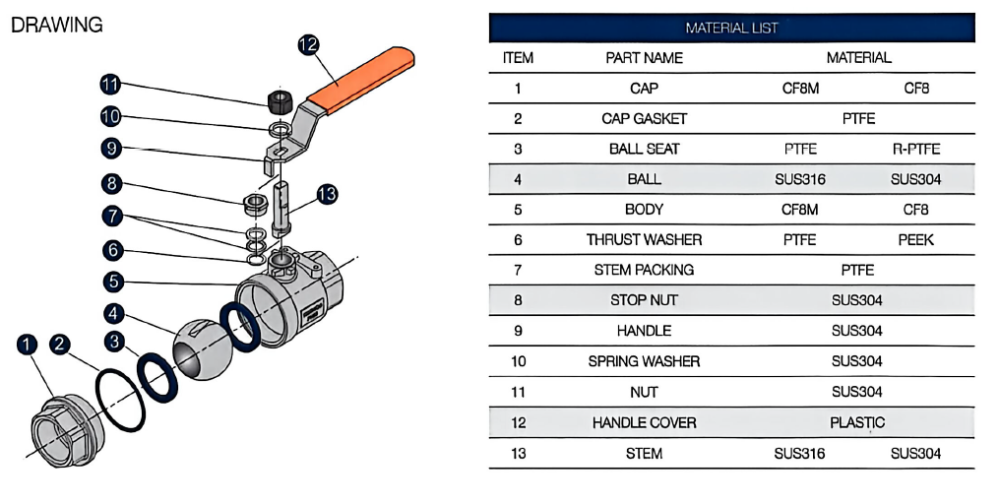
Which Ball Valve Style is Easiest to Service?
Serviceability depends on how the valve body is built. A 3-piece ball valve is usually the easiest style to service and clean because the center body section can be removed for direct access to the ball, seats, seals, and internal cavity.
A serviceable 1-piece ball valve can also be serviced through a removable internal end cap. This makes seat and packing replacement practical, although cleaning access is usually not as open as a 3-piece design. A 2-piece ball valve may also be serviceable, but it is typically the most difficult of the three because the two body sections usually need to be separated with the valve removed from the line.
| Valve Style | Service Access | Typical Maintenance Use |
|---|---|---|
| 3-piece ball valve | Removable center section | Best for cleaning, inspection, and frequent maintenance |
| Serviceable 1-piece ball valve | Removable internal end cap using an Allen key | Good for seat and stem packing replacement in compact valve designs |
| 2-piece ball valve | Body sections must be separated | Serviceable in some cases, but usually more difficult to disassemble |
Serviceable 3-Piece Ball Valves
A 3-piece ball valve is usually the easiest threaded ball valve style to service. The valve body is built with two end connections and a removable center section, allowing technicians to access the ball, seats, and seals more easily than with many compact valve designs.
In many installations, the center section of a 3-piece valve can be removed while the threaded ends remain connected to the piping. This can reduce downtime during inspection, cleaning, or seat replacement.
➤ For service-focused valve options, view our 3-piece stainless steel ball valves. For a broader construction comparison, see our guide to 2 piece vs 3 piece ball valves.
3 Piece Ball Valve Repair
3 piece ball valve repair commonly involves isolating the line, relieving pressure, removing the valve center section, inspecting the ball and body cavity, replacing worn PTFE seats or seals, and reassembling the valve according to the manufacturer’s instructions.
The valve should not be serviced while pressurized. Before disassembly, the line should be isolated, drained, and confirmed safe for maintenance. The fluid type, pressure, temperature, and any hazardous media concerns should be reviewed before the valve is opened.
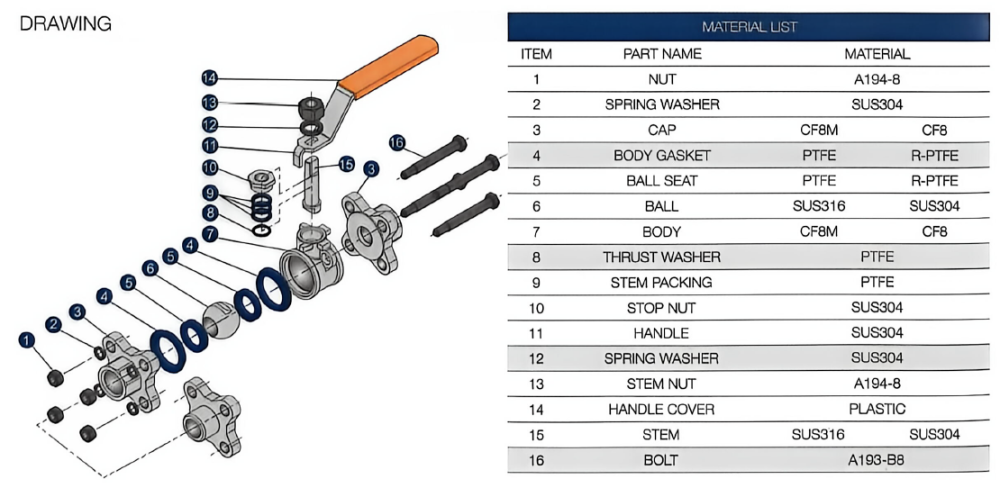
How to Service a 3 Piece Ball Valve
A 3 piece ball valve is designed so the center body section can be removed for inspection, cleaning, and maintenance. This allows access to the ball, PTFE seats, seals, and internal cavity without necessarily removing the threaded end connections from the piping system.
Before servicing any valve, make sure the pipeline is fully drained and depressurized. If the valve is not connected to the application, it can typically be serviced with basic hand tools.
3 Piece Ball Valve Disassembly
- Remove the 4 body bolts: Loosen the nuts that hold the body bolts in place, then remove the bolts. This disconnects the center body from the two end connections. If the valve is still installed in the pipeline, the end connections usually remain attached to the piping.
- Separate the center body: Gently slide the center section out from between the two end connections. This exposes the ball, seats, and internal sealing components.
- Remove the seats: Remove one or both PTFE seats. If the seats are difficult to remove by hand, a small pick can help lift them out carefully.
- Remove the ball: Turn the handle to the closed position, then gently remove the ball from the center body.
How to Reassemble a 3 Piece Ball Valve
- Clean internal parts: Make sure the ball, seats, and internal body surfaces are clean and free from grime, residue, or debris. In many cases, soaking the center body and internal parts in soapy water is sufficient. If buildup remains, clean the parts with a wet cloth or soft toothbrush.
- Position the ball: Turn the valve handle to the closed position, then gently set the ball into the center body. Make sure the groove on top of the ball aligns with the valve stem.
- Install the seats: If the old seats are worn, cut, deformed, or contaminated, install new PTFE seats on each side of the ball. Light lubrication may be useful in certain applications if compatible with the service media.
- Reattach the center body: Slide the center section back between the two end connections. Insert the 4 bolts and tighten the nuts gradually in a criss-cross pattern so the body seats evenly.
- Check handle movement: Move the handle from open to closed several times. The movement should feel smooth without binding, scraping, or uneven resistance.
- Check for leaks: Once the valve is back in service, slowly pressurize the system and inspect the body joints, stem area, and end connections for signs of leakage.
Typical 3 Piece Ball Valve Service Items
- PTFE seats
- Body seals
- Stem packing
- Thrust washers
- Handle hardware
- Ball and stem inspection
- PTFE seat and stem packing repair kits
Serviceable 1-Piece Ball Valve Repair
Unlike many traditional one-piece ball valves, a serviceable 1-piece ball valve can be designed with a removable internal end cap. This allows the valve to be opened from one end so the PTFE seats, ball, stem packing, and related internal components can be accessed.
The internal end cap uses a hexagon-shaped socket designed to receive an Allen key wrench. Once the end cap is unscrewed from the valve body, the first seat, ball, second seat, and stem components can be removed for inspection or replacement.
Servicing is usually easier when the valve is removed from the line because the opposite port can be used to push the seat out with a rod while partly opening and closing the ball. In some installations, one side may remain connected if the disconnected port gives enough access and a hooked pick can be used to remove the seat carefully.
➤ View our 1-piece stainless steel ball valves for compact threaded shut-off applications where serviceable designs are available.
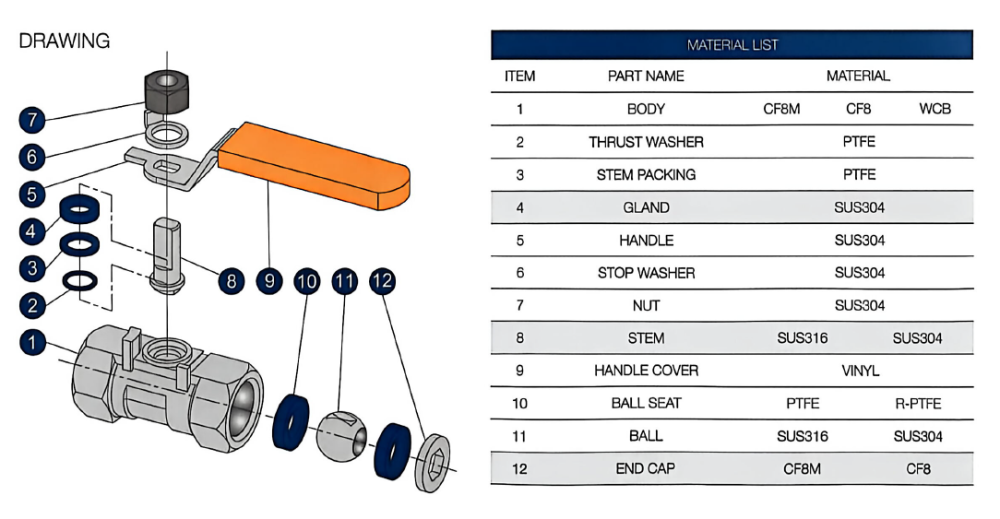
1 Piece Ball Valve Disassembly
- Isolate and depressurize the system: Make sure the line is drained, depressurized, and safe before servicing the valve.
- Remove the valve when practical: Removing the valve from the pipeline gives better access to both ports and makes seat removal easier.
- Remove the internal end cap: Insert the correct Allen key into the hexagon-shaped socket in the end cap and unscrew the end cap from the valve body.
- Remove the first seat: Take out the exposed PTFE seat from the end cap side of the valve.
- Remove the ball: Partly open and close the valve as needed, then carefully remove the ball from the valve body.
- Remove the second seat: Push the opposite seat out from the other port with a rod, or carefully remove it with a hooked pick if access is limited.
- Remove the stem components: If stem packing replacement is required, remove the handle hardware and stem assembly according to the valve design.
How to Reassemble a Serviceable 1-Piece Ball Valve
- Clean the valve body: Remove residue, debris, old sealing material, or contamination from the internal cavity and sealing surfaces.
- Inspect the ball and stem: Check the ball surface and stem for scoring, corrosion, deformation, or damage before reuse.
- Install stem packing: If the repair kit includes stem packing and gland gasket components, install them before final internal assembly.
- Install the first seat: Position the first PTFE seat correctly inside the valve body.
- Install the ball: Align the ball with the stem and place it carefully into the valve body.
- Install the second seat: Place the second PTFE seat into position against the ball.
- Reinstall the end cap: Thread the internal end cap back into the valve body and tighten it with the correct Allen key.
- Check operation: Open and close the valve several times to confirm smooth quarter-turn movement.
- Leak test after installation: Reinstall the valve, slowly pressurize the system, and inspect the end cap, stem area, and threaded connections for leakage.
Typical 1 Piece Ball Valve Repair Kit Components
- Two replacement PTFE seats
- Stem packing gasket
- Gland gasket
- Replacement ball if required and available
- Replacement stem if required and available
Although the ball, PTFE seats, stem packing, and seals can be replaced in a serviceable 1-piece design, the most common maintenance items are usually the PTFE seats and stem packing. These soft sealing components experience the most wear during normal valve operation.
2-Piece Ball Valve Repair and Servicing
A 2-piece ball valve may be serviceable depending on the valve design, but it is usually more difficult to service than a 3-piece valve or a serviceable 1-piece valve with a removable internal end cap. The two body sections generally need to be separated to access the ball, seats, and internal sealing components.
In most cases, a 2-piece valve should be removed from the line before disassembly. The body is typically held firmly in a vice while the threaded body section is loosened with a pipe wrench or suitable tool. This requires more force and more care than servicing a 3-piece center section or removing a 1-piece internal end cap.
For a broader construction comparison, see our guide to 1 piece vs 2 piece ball valves.
2 Piece Ball Valve Disassembly
- Remove the valve from the line: Isolate, drain, depressurize, and remove the valve from the piping system before attempting disassembly.
- Secure the valve body: Hold the main body carefully in a vice without crushing or deforming the valve.
- Unscrew the body section: Use an appropriate wrench to loosen and unscrew the threaded body section. Avoid damaging the threads or wrenching surfaces.
- Remove the exposed seat: Take out the first PTFE seat once the body section has been removed.
- Remove the ball: Turn the handle as needed and carefully remove the ball from the body cavity.
- Remove the second seat: Remove the remaining PTFE seat and inspect the internal sealing surfaces.
- Inspect stem packing: If the valve design allows, inspect or replace the stem packing and related stem sealing components.
How to Reassemble a 2 Piece Ball Valve
- Clean internal parts: Clean the ball, seats, body cavity, threads, and sealing surfaces before reassembly.
- Inspect the ball: Check for scratches, corrosion, or embedded debris that could damage new seats.
- Install replacement seats: Replace worn, cut, or deformed PTFE seats if repair parts are available.
- Position the ball: Align the ball with the stem and place it back into the body.
- Reattach the body section: Thread the body section back into place and tighten securely without over-stressing the valve body.
- Check handle movement: Cycle the valve from open to closed and confirm smooth operation.
- Leak test before return to service: Reinstall the valve and slowly pressurize the system while checking the stem, body joint, and threaded ends.
Because 2-piece ball valve servicing often requires more tools, more force, and more removal time, replacement may be more practical in some applications. However, when repair parts are available and the body, ball, and stem are still in good condition, seat and packing replacement may restore proper valve operation.
Repairable Ball Valve vs Non-Serviceable Valve
Not every ball valve is worth repairing. Traditional compact 1-piece valves are often replaced rather than rebuilt when internal access is limited. However, serviceable 1-piece designs with removable end caps can allow seat and packing replacement. Some 2-piece valves may also be serviceable, but they usually require more removal and handling than 3-piece valves.
A repairable ball valve is most valuable when downtime, cleaning access, or recurring maintenance cost matters. That is why 3-piece valves are often selected for process lines, washdown systems, chemical handling, and industrial applications where the valve may need to be opened for inspection or seat replacement.
Ball Valve Troubleshooting Guide
| Problem | Possible Cause | Recommended Check |
|---|---|---|
| Leak at stem | Worn stem packing or loose gland area | Inspect stem packing and handle assembly |
| Leak through closed valve | Seat wear, debris, or damaged ball surface | Inspect seats, ball surface, and fluid contamination |
| Hard to turn handle | Debris, seat swelling, corrosion, or over-tight packing | Check operating torque and internal condition |
| Valve will not fully close | Obstruction, handle misalignment, or ball damage | Verify handle position and inspect bore area |
| Repeated seal failure | Incorrect media, pressure, temperature, or cycling conditions | Review valve material compatibility and pressure rating |
Pressure, Temperature, and Valve Life
Pressure and temperature have a direct effect on ball valve service life. A valve that performs well at room temperature may have lower pressure capacity at elevated temperatures. Seats, seals, and packing materials often determine the practical service limits of the valve assembly.
If a ball valve fails repeatedly, the problem may not be the repair procedure. The valve may be undersized for the service conditions, exposed to pressure spikes, installed in a high-temperature line, or used with media that is not compatible with the sealing materials.
➤ For more detail on rating selection, see our guide to ball valve pressure ratings.
Preventative Ball Valve Maintenance
Preventative maintenance helps reduce unexpected valve failures and shutdowns. The right maintenance schedule depends on fluid type, pressure, temperature, cycle frequency, and whether the valve is installed in a clean utility line or a demanding process system.
Common preventative maintenance steps include:
- Operate valves periodically to prevent sticking in low-cycle service
- Inspect for stem leakage, corrosion, or external body damage
- Check handle alignment and locking hardware
- Verify that the valve is not being used beyond its pressure-temperature rating
- Flush debris from lines where contamination may damage seats
- Replace seats, seals, or packing during planned maintenance where applicable
- Use repairable valves where routine cleaning or inspection is expected
When to Replace a Ball Valve Instead of Repairing It
Replacement is usually the safer option when the valve body is cracked, threads are damaged, the ball is badly scored, the valve has been exposed to incompatible chemicals, or the original pressure and temperature rating is not suitable for the system.
Replacement may also be more practical for compact low-cost valves where labor time exceeds the value of the repair. In applications where downtime is expensive or repeated maintenance is expected, upgrading to a serviceable 3-piece valve may be the better long-term choice.
Frequently Asked Questions
Can a ball valve be repaired?
Some ball valves can be repaired if they are designed for service. 3-piece ball valves are usually the easiest to inspect, clean, and repair. Serviceable 1-piece ball valves may allow seat and stem packing replacement through a removable end cap, while some 2-piece valves can be serviced after the body sections are separated.
What causes a ball valve to leak?
A ball valve may leak because of worn PTFE seats, damaged stem packing, debris between the ball and seat, a scratched ball surface, chemical attack, pressure spikes, or use outside the valve’s pressure-temperature rating.
Can PTFE ball valve seats be replaced?
PTFE seats can be replaced on many repairable ball valves. This includes many 3-piece valves, serviceable 1-piece designs with removable end caps, and some 2-piece valves where the body can be separated for access.
Why is a 3-piece ball valve easier to repair?
A 3-piece ball valve has a removable center body section that gives better access to the ball, seats, and seals. This design makes inspection, cleaning, and seat replacement easier than with many compact valve bodies.
Can a 1-piece ball valve be serviced?
Some serviceable 1-piece ball valves can be repaired through a removable internal end cap. The end cap can be removed with an Allen key, allowing access to the PTFE seats, ball, stem packing, and related internal components.
Is a 2-piece ball valve serviceable?
Some 2-piece ball valves are serviceable, but they are usually more difficult to disassemble than 3-piece or serviceable 1-piece valves. In many cases, the valve must be removed from the line and the two body sections must be separated to access the seats and ball.
Should a leaking ball valve be repaired or replaced?
A leaking valve may be repaired if it is serviceable and the body, ball, and stem are still in good condition. Replacement is usually better when the valve body, threads, or internal metal surfaces are damaged.
How can ball valve failures be prevented?
Ball valve failures can be reduced by selecting the correct pressure rating, checking temperature limits, using compatible media, flushing debris from lines, operating valves periodically, and choosing serviceable valves where maintenance access is important.
Related Ball Valve Resources
➤ What is a Ball Valve?
Learn how ball valves work, how quarter-turn shut-off valves operate, common valve types, and typical industrial applications.
➤ Ball Valve Applications
Learn how stainless steel ball valves are used in water systems, oil and gas piping, chemical processing, compressed air systems, food processing, hydraulic systems, and industrial fluid control.
➤ Ball Valve Parts and Components
Learn how valve bodies, balls, PTFE seats, stems, seals, packing, handles, and threaded end connections function in industrial ball valves.
➤ How to Install a Threaded Ball Valve
Learn how thread preparation, PTFE tape application, tightening methods, valve orientation, and leak testing affect long-term valve performance.
➤ Ball Valve Pressure Ratings Explained
Understand WOG meaning, PSI ratings, pressure-temperature derating, and how pressure conditions affect valve selection.
➤ 304 vs 316 Stainless Steel Ball Valves
Compare corrosion resistance, chemical compatibility, marine performance, and how stainless steel grade affects valve life and maintenance requirements.
➤ 1 Piece vs 2 Piece Ball Valve
Compare compact reduced-port valve construction with two-piece full-port valve designs used in industrial shut-off systems.
➤ 2 Piece vs 3 Piece Ball Valve
Learn how valve body construction affects serviceability, maintenance access, cleaning, and long-term repair considerations.
Shop Stainless Steel Ball Valves
➤ Browse Stainless Steel Ball Valves
View stainless steel ball valves for threaded piping, shut-off service, industrial flow control, and pressure-rated applications.
➤ View 3 Piece Ball Valves
Compare serviceable 3-piece stainless steel ball valves designed for easier inspection, cleaning, and maintenance access.
➤ Shop 1 Piece Ball Valves
View compact stainless steel ball valves, including serviceable designs with removable end caps for seat and packing replacement.
➤ Shop 2 Piece Full Port Ball Valves
View threaded full-port stainless steel ball valves for general industrial shut-off and low-restriction flow control.
