

Stainless Steel Ball Valves
Stainless steel ball valves are widely used in industrial piping systems for reliable quarter-turn shut-off control of water, oil, gas, compressed air, and chemically compatible fluids. This range includes 1-piece, 2-piece, 3-piece, and 3-way threaded ball valves, available in both reduced (standard) port and full port designs.
These threaded ball valves feature durable stainless steel construction with female NPT threaded connections and are commonly rated to 1000 WOG, with additional high-pressure options available. Available in 304 stainless steel and 316 stainless steel, they are widely used in industrial fluid-control and shut-off applications.
- ● Ball valve suppliers, call us or 'Click Here' to apply for special pricing.
- ● Click the 'Shop Now' Icon to Start
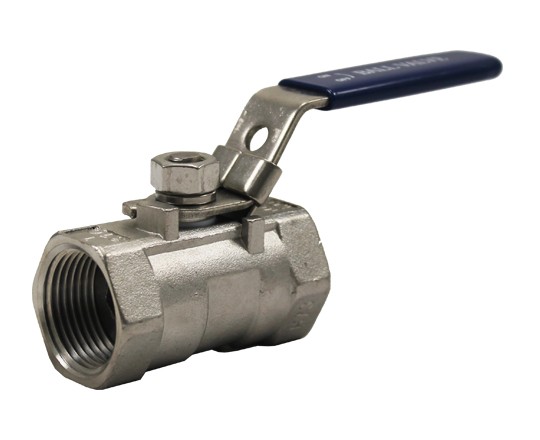
1 Piece Ball Valves
● The Valve Body is made out of One Piece, with no joints, which reduces the chance of leaks● Durable and cost-effective
● Standard or Reduced Port (Pipe ID drops one size)
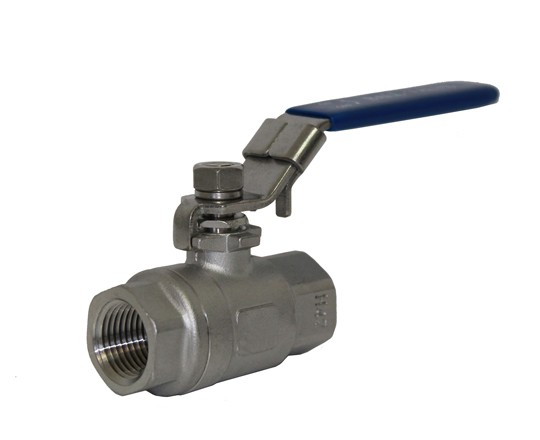
2 Piece Ball Valves
● The Valve Body is made out of Two Pieces● The most widely used full-port threaded ball valve
● Full Port or Full Bore Ball Valve (Pipe ID remains constant)
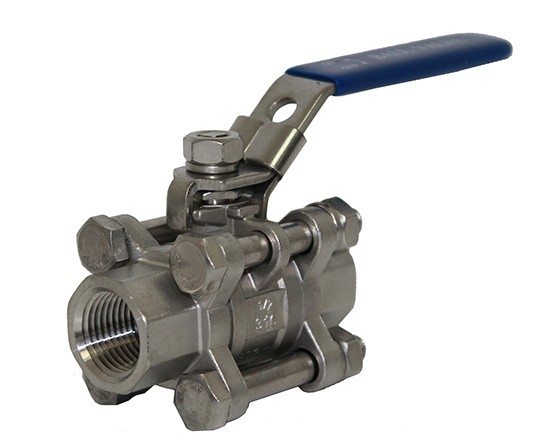
3 Piece Ball Valves
● Valve Body is made out of Three Pieces● Designed to be taken apart for servicing, cleaning, and maintenance
● Full Port or Full Bore (Pipe ID remains constant)
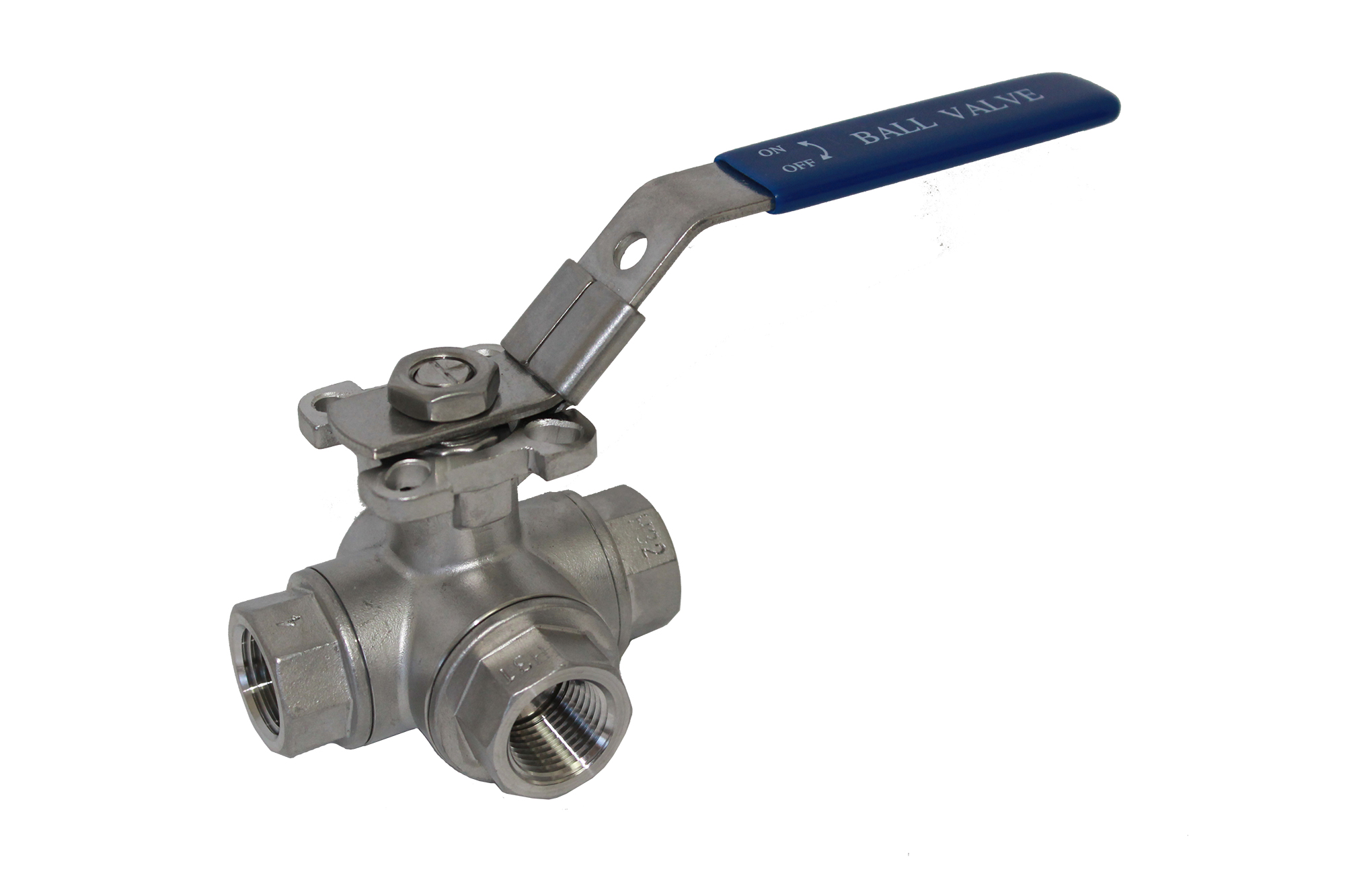
3 Way Ball Valves
● 3 Ports to Direct Flow● Used to Divert, Mix, or Redirect Flow
● Reduced Port (Pipe ID is one size less than the pipe it connects to)
Ball Valve Features:
- ● Thread: Female NPT threads on both ends. Male threads are available by special order.
- ● Port: Available in reduced (standard) port and full port designs depending on the required flow capacity and application.
- ● Pressure Rating: Commonly rated to 1000 WOG (1000 PSI) for general industrial fluid-control applications.
- ● WOG Suitable: Suitable for water, oil, gas, and compatible fluids within the valve’s rated pressure and temperature range.
- ● Seals: Internal seats and seals are made from Teflon (PTFE), which provides chemical resistance, heat resistance, and reliable shut-off performance.
- ● Handle: The lever handle requires a quarter-turn (90-degree) rotation to fully open or close the flow of fluid.
- ● Blowout Proof Stem: Helps prevent the stem and handle from being pushed out of the valve body by internal pressure.
- ● Locking Handle: The lever handle includes a locking device that can secure the valve in the open or closed position.
- ● Two Way: Designed with two ports, an inlet and an outlet, for straight-line flow control.
- ● Bidirectional: Designed to allow flow in either direction.
Threaded Ball Valves:
Threaded ball valves, also known as NPT ball valves, are among the most widely used valve types for industrial fluid-control systems. They are commonly used to control the flow of water, oil, gas, compressed air, and chemically compatible fluids in pipelines, pumps, processing equipment, and industrial machinery.
These stainless steel ball valves feature female NPT threaded ends that allow for quick installation and removal without the need for welding or flanges. Male threaded configurations are also available by special order. Their threaded design makes them ideal for systems that may require maintenance, replacement, or future modifications.
Inside the valve body is a rotating stainless steel ball with a drilled bore through the center. Turning the handle a quarter turn (90 degrees) rotates the ball to either fully open or fully close the flow. Their simple quarter-turn operating design allows for fast shut-off control and easy operation in industrial piping systems.
Threaded stainless steel ball valves are available in a wide range of sizes, typically from 1/4 inch up to 4 inches, and are manufactured in several configurations, including:
- ● 1-piece reduced-port ball valves
- ● 2-piece full-port ball valves
- ● 3-piece serviceable ball valves
- ● 3-way diverting and mixing ball valves
Common advantages of threaded ball valves include easy installation, reliable shut-off performance, corrosion resistance, compact design, and low maintenance requirements. They are widely used in industrial piping systems, chemical processing, water treatment, food processing, compressed air systems, hydraulic systems, and general-purpose shut-off applications.
Full Port vs Standard Port Ball Valves:
Stainless steel ball valves are commonly manufactured in either standard-port or full-port designs. The primary difference between these valve types is the internal bore diameter through the valve body and how it affects flow performance.
Standard-port ball valves use a smaller internal bore that is typically one pipe size smaller than the pipeline to which the valve is connected. This smaller opening creates a slight pressure drop and reduces maximum flow capacity. These reduced-port valve designs are generally more compact, lighter, and cost-effective, making them suitable for applications where unrestricted flow is not critical.
Full-port ball valves use a larger internal bore that matches the inside diameter of the connected pipeline. This allows fluid to pass through with minimal restriction and minimal pressure loss. Full-port ball valves are commonly used in systems where maintaining maximum flow rate and flow efficiency is important.
Because full-port valves require a larger internal ball and body, they are generally larger and heavier than standard-port valves. However, they are preferred for many industrial systems where unrestricted flow, lower turbulence, and reduced pressure drop are important.
- ● Standard Port: Compact and cost-effective with slight flow restriction
- ● Full Port: Maximum flow capacity with minimal pressure drop
➤ Full Port vs Standard Port Ball Valves
Compare flow restriction, pressure drop, bore size differences, and common industrial applications for full port and standard port ball valve designs.
Many stainless steel threaded ball valves are rated to 1000 WOG, which indicates suitability for common water, oil, and gas service applications up to 1000 PSI at normal ambient temperatures. This classification helps identify valves suitable for safely handling common industrial fluids under rated pressure conditions.
The term WOG is formed from the first letters of Water, Oil, and Gas. When combined with a pressure rating, such as 1000 WOG, it identifies the maximum non-shock pressure rating for compatible fluids within standard industrial service conditions.
In addition to standard 1000 WOG valves, higher-pressure stainless steel ball valves are also available for more demanding industrial applications, including:
These higher-pressure valves are commonly used in hydraulic systems, industrial processing equipment, chemical systems, and other applications where elevated operating pressures are present.
➤ Ball Valve Pressure Ratings Explained
Learn how WOG ratings, PSI ratings, pressure-temperature relationships, steam ratings, and pressure derating affect ball valve selection and performance.
Seals and PTFE Seats:
Stainless steel ball valves commonly use Teflon (PTFE) seats and seals because of their excellent chemical resistance, low friction properties, and broad temperature compatibility. PTFE provides a smooth sealing surface that allows the internal ball to rotate easily while maintaining reliable shut-off performance.
PTFE seals are resistant to many chemicals, oils, solvents, and industrial fluids, making them suitable for a wide range of industrial applications. Their low-friction properties also help reduce wear on internal components and extend service life.
Quarter-Turn Handle Operation:
Ball valves operate through a quarter-turn handle design that controls the position of the internal stainless steel ball. As the handle moves, the opening through the internal ball changes position, either lining up with the passage through the valve or blocking it from flow.
When the handle is positioned in line with the piping system, the valve permits flow through the bore opening. Rotating the handle to a crosswise position closes off the internal passage and isolates the pipeline.
These valves are commonly referred to as quarter-turn ball valves because the handle only requires a 90-degree rotation to fully open or fully close the flow path.
Blowout Proof Stem and Locking Handle:
Many stainless steel ball valves are designed with a blowout proof stem that helps prevent internal pressure from forcing the valve stem out of the body. This safety design improves reliability and helps protect against leaks in high-pressure or demanding industrial applications.
Premium stainless steel ball valves may also include a locking handle mechanism that secures the valve in either the open or closed position. This added safety feature helps prevent accidental operation during service or maintenance.
What is a Stainless Steel Ball Valve?
A stainless steel ball valve is used to start, stop, or isolate the flow of fluids within a piping system. It operates similarly to a faucet or tap by using a rotating internal ball mechanism to control flow through the valve body. Turning the handle rotates the drilled bore of the ball, allowing fluid to pass through the pipeline or shutting the flow off completely.
Ball valves are typically designed for fully open or fully closed operation, making them highly effective for shut-off applications. Manufactured from stainless steel, they offer excellent corrosion resistance, durability, and the ability to handle demanding industrial pressure and temperature conditions.
Several body styles are available depending on the application requirements, including One Piece Ball Valves, Two Piece Ball Valves, Three Piece Ball Valves, and Three-Way Ball Valves.
➤ 304 vs 316 Stainless Steel Ball Valves
Compare corrosion resistance, chemical compatibility, marine performance, cost differences, and how to choose between 304 and 316 stainless steel for industrial ball valve applications.
What is a Threaded Ball Valve?
A threaded ball valve is a ball valve with threaded end connections that allow it to be installed directly into threaded piping, equipment, pumps, and fittings without welding or flanges. Most threaded stainless steel ball valves use female NPT connections, making them easy to install, remove, or replace during maintenance.
Threaded ball valves are commonly used in industrial piping systems because they provide reliable on/off shut-off control, compact installation, and simple quarter-turn operation. They are available in reduced-port, full-port, 2-piece, 3-piece, high-pressure, and 3-way configurations depending on the required flow capacity, pressure rating, and application.
WOG Meaning in Valves:
WOG stands for Water, Oil, and Gas. When used with a pressure rating, such as 1000 WOG, it identifies the maximum non-shock pressure rating a valve can handle for compatible water, oil, and gas applications at normal ambient temperatures. This rating system helps users quickly identify valves suitable for general industrial fluid-control service.
1000 WOG Valves:
1000 WOG stainless steel ball valves are commonly used in industrial piping systems that require reliable shut-off control and moderate-to-high pressure handling capability. Their corrosion resistance, quarter-turn operation, and durable stainless steel construction make them suitable for water systems, compressed air systems, oil lines, chemical processing, and many general industrial applications.
How to Use a Ball Valve:
Ball valves are controlled by rotating the handle. A short 90-degree movement turns the internal ball to either permit fluid flow or shut the passage off completely. When the handle points in the same direction as the piping, the valve remains open. Turning the handle across the pipe closes the valve and stops the movement of fluid.
Ball Valve Throttling: Controlling the Flow Rate
Although ball valves are primarily designed for fully open or fully closed operation, they can also be partially opened to regulate flow rate and system pressure. This type of partial opening is usually described as throttling or flow regulation.
While throttling can be effective for temporary flow adjustment, ball valves are generally not intended for prolonged throttling service. Extended operation in partially open positions may increase wear on the seats and internal sealing surfaces due to higher fluid velocity and turbulence.
Ball Valve Applications:
Stainless steel ball valves are widely used across industrial, commercial, agricultural, and processing systems where dependable shut-off control is required. Their corrosion resistance, quarter-turn operation, pressure-handling capability, and durable stainless steel construction make them suitable for a broad range of fluid-control applications.
Threaded ball valves are commonly installed in water systems, oil transfer lines, compressed air systems, chemical processing equipment, hydraulic systems, food processing operations, washdown environments, and general industrial piping systems. Their simple installation and reliable sealing performance make them a practical choice for both permanent piping installations and systems that may require periodic maintenance or valve replacement.
Different ball valve configurations are selected depending on the application requirements. Standard-port valves are often used where compact size and cost efficiency are important, while full-port ball valves are preferred in systems requiring maximum flow capacity and minimal pressure loss. Three-piece ball valves are commonly selected for applications requiring cleaning or servicing, while 3-way ball valves are used to divert, combine, or redirect flow between multiple pipeline paths.
➤ Ball Valve Applications
Learn how stainless steel ball valves are used in water systems, oil and gas piping, chemical processing, compressed air systems, food processing, hydraulic systems, and industrial fluid control.
Different Types of Threaded Ball Valves:
Threaded stainless steel ball valves are available in several body styles, each designed for different flow requirements, installation conditions, pressure demands, and maintenance needs. One of the most common ways to classify 2-way ball valves is by the number of body sections used in the valve construction.
In general, 1-piece ball valves are compact reduced-port valves designed for durability and cost efficiency, while 2-piece and 3-piece ball valves are commonly manufactured as full-port valves to provide improved flow performance. 3-way ball valves are used where flow needs to be diverted, mixed, or directed between multiple flow paths.
➤ What is a Ball Valve?
Start with our foundational guide explaining how ball valves work, how quarter-turn shut-off valves operate, common valve types, and how threaded stainless steel ball valves are used in industrial piping systems.
➤ How to Install a Threaded Ball Valve
Learn how threaded ball valves are installed, including NPT thread preparation, PTFE tape use, tightening methods, valve orientation, and leak checking.
➤ 1 Piece vs 2 Piece Ball Valve
Compare valve construction, flow restriction, reduced-port vs full-port design, compact body styles, and common industrial applications.
➤ 2 Piece vs 3 Piece Ball Valve
Compare valve construction, maintenance access, serviceability, repairability, and common industrial applications.
➤ Ball Valve Repair and Maintenance
Learn how leaking ball valves are repaired, how PTFE seats and seals are serviced, and why 3-piece stainless steel ball valves are commonly used for maintenance-focused industrial applications.
➤ Ball Valve Parts and Components
Learn how ball valve bodies, PTFE seats, stems, seals, handles, threaded ends, and internal wear components function in stainless steel industrial ball valves.
One Piece:
- ● 1-piece ball valves are manufactured from a single valve body, creating a compact and highly durable design.
- ● Because the body is made from one section, there are fewer body joints and fewer potential leak paths.
- ● Their compact construction requires less material, making them one of the most economical stainless steel ball valve options.
- ● They are commonly used in industrial systems where reliability, compact installation space, and simple shut-off control are important.
- ● Most 1-piece valves are manufactured as reduced-port valves, making them suitable for applications where unrestricted maximum flow is not critical.
Two Piece:
- ● 2-piece ball valves are among the most widely used threaded stainless steel ball valves in industrial piping systems.
- ● The valve body is manufactured from two threaded body sections, allowing for a larger internal ball and full-port flow design.
- ● Their full-port construction helps maintain flow efficiency by minimizing pressure drop and flow restriction.
- ● 2-piece full-port ball valves are commonly selected for water systems, compressed air systems, chemical processing, oil systems, and general industrial fluid-control applications.
- ● They are available in standard-duty, heavy-duty, 2000 PSI, and 3000 PSI configurations depending on system pressure requirements.
Three Piece:
- ● 3-piece ball valves are designed for applications where cleaning, maintenance, inspection, or seal replacement may be required.
- ● The three-piece bolted body construction allows the center section of the valve to be removed without disconnecting the threaded pipe connections.
- ● Most 3-piece valves are manufactured with full-port flow paths for minimal pressure loss and unrestricted flow.
- ● They are commonly used in industrial processing systems, chemical applications, food processing, sanitary systems, and other applications where serviceability is important.
- ● Their serviceable design also makes them suitable for applications requiring periodic cleaning or internal component replacement.
Three Way:
- ● 3-way ball valves are designed to control flow between multiple pipeline paths rather than simply turning flow on or off.
- ● They are commonly used to divert flow, redirect fluid between different lines, or combine multiple flow paths within a system.
- ● Using a single 3-way valve can reduce the need for additional valves and piping connections.
- ● The two most common configurations are L-port and T-port flow patterns.
- ● L-Port 3-Way Ball Valves: Used to direct flow between two separate outlet paths.
- ● T-Port 3-Way Ball Valves: Allows flow to be combined, split, or distributed between multiple connections.
➤ L Port vs T Port Ball Valves
Compare diverting vs mixing flow paths, handle positions, and common 3-way industrial applications for L-port and T-port ball valves.
Ball Valve Selection Guide
| Valve Type | Port Style | Main Advantage | Common Applications |
|---|---|---|---|
| 1-Piece Ball Valves | Standard Port | Compact and economical design | General shut-off and industrial piping systems |
| 2-Piece Ball Valves | Full Port | Improved flow performance and versatility | Industrial fluid-control systems and general process piping |
| 3-Piece Ball Valves | Full Port | Easy maintenance and serviceability | Chemical processing, food processing, and systems requiring cleaning |
| 3-Way Ball Valves | Reduced/Standard Port | Flow diversion and directional control | Mixing, diverting, and multi-line flow systems |
Frequently Asked Questions About Stainless Steel Ball Valves
What is a stainless steel ball valve?
A stainless steel ball valve is a quarter-turn shut-off valve used to control the flow of liquids and gases through a piping system. It uses a rotating stainless steel ball with a drilled opening to start or stop flow.
What does 1000 WOG mean on a ball valve?
1000 WOG indicates that the valve is rated for Water, Oil, and Gas applications up to 1000 PSI under normal operating conditions.
What is the difference between full-port and reduced-port ball valves?
Full-port ball valves use a larger internal bore that closely matches the pipe diameter for maximum flow capacity, while reduced-port valves use a smaller internal opening that slightly restricts flow.
What are stainless steel ball valves used for?
Stainless steel ball valves are commonly used in water systems, oil lines, compressed air systems, chemical processing, food processing, industrial piping systems, and general shut-off applications.
What is the difference between 2-piece and 3-piece ball valves?
2-piece ball valves are widely used for general industrial shut-off applications, while 3-piece ball valves are preferred in systems where internal cleaning, inspection, or replacement of sealing components may eventually be required.
Can stainless steel ball valves be repaired?
Yes, many stainless steel ball valves can be serviced or repaired by replacing seats, seals, stem packing, or other internal components, depending on the valve design. Serviceable 1-piece, 2-piece, and 3-piece ball valves can all be maintained and repaired.
Related Ball Valve Resources
➤ What is a Ball Valve?
Learn how ball valves work, how quarter-turn shut-off valves operate, common valve types, and typical industrial applications.
➤ 304 vs 316 Stainless Steel Ball Valves
Compare corrosion resistance, chemical compatibility, marine performance, and material selection considerations.
➤ Ball Valve Applications
Learn how stainless steel ball valves are used in water systems, oil and gas piping, chemical processing, compressed air systems, food processing, hydraulic systems, and industrial fluid control.
➤ Ball Valve Parts and Components
Understand valve bodies, balls, PTFE seats, seals, stems, handles, and threaded end connections.
➤ Ball Valve Repair and Maintenance
Learn how ball valves are serviced, repaired, inspected, and maintained in industrial applications.
➤ Ball Valve Pressure Ratings Explained
Understand WOG ratings, PSI ratings, pressure-temperature relationships, and pressure derating.
➤ How to Install a Threaded Ball Valve
Learn about NPT thread preparation, PTFE tape use, tightening methods, valve orientation, and leak testing.
➤ Full Port vs Standard Port Ball Valves
Compare bore size, pressure drop, flow restriction, and common industrial applications.
➤ 1 Piece vs 2 Piece Ball Valve
Compare compact reduced-port one-piece valves with two-piece full-port designs, including flow characteristics, serviceability, and common industrial applications.
➤ 2 Piece vs 3 Piece Ball Valve
Learn how valve body construction affects maintenance access, repairability, cleaning requirements, and long-term industrial service.
➤ L Port vs T Port Ball Valve
Compare diverting and mixing flow paths used in 3-way ball valves, including bypass routing, distribution, and multi-port flow control.