

Understanding the Difference Between Full Port and Standard Port Ball Valves
Full Port vs Standard Port Ball Valves
Ball valves are commonly manufactured in two primary flow styles: full port and standard port, with standard port designs also commonly referred to as reduced port ball valves. The key difference is the size of the opening through the valve ball compared with the pipe it connects to. That one design difference can affect flow rate, pressure loss, body size, weight, and overall cost.
Choosing between a full port and reduced port ball valve depends on how much flow the system needs, how much pressure drop is acceptable, and whether compact size or maximum flow performance is more important for the application.
In industrial piping systems, the terms full port, reduced port, and standard port are frequently compared when selecting the correct valve style. Understanding the differences between a full port ball valve vs standard port ball valve can help determine which option is better suited for the required flow performance, pressure conditions, and installation requirements. If you're new to ball valves, start with our what is a ball valve guide for an overview of valve operation, construction, and common industrial applications.
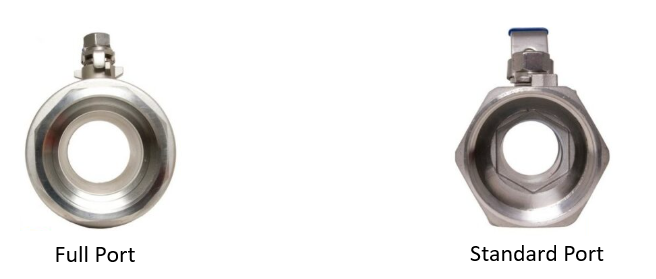
Full Port Ball Valve vs Standard Port Ball Valve Comparison
| Feature | Full Port Ball Valve | Reduced Port / Standard Port Ball Valve |
|---|---|---|
| Internal Bore Size | Matches pipe inside diameter | Smaller than pipe inside diameter |
| Flow Restriction | Minimal restriction | Slight restriction |
| Pressure Drop | Lower pressure loss | Slightly higher pressure loss |
| Flow Capacity | Maximum flow capacity | Reduced flow capacity |
| Valve Size | Larger body and ball | More compact body |
| Weight | Heavier | Lighter |
| Cost | Higher cost | More economical |
| Common Applications | Process systems and unrestricted flow applications | General shut-off and cost-sensitive applications |
Quick Selection Guide
| If Your System Requires | Recommended Valve Type |
|---|---|
| Maximum flow capacity | Full Port Ball Valve |
| Minimal pressure loss | Full Port Ball Valve |
| Compact installation space | Reduced Port / Standard Port Ball Valve |
| Lower valve cost | Reduced Port / Standard Port Ball Valve |
| General shut-off service | Reduced Port / Standard Port Ball Valve |
| High-flow process piping | Full Port Ball Valve |
What is a Full Port Ball Valve?
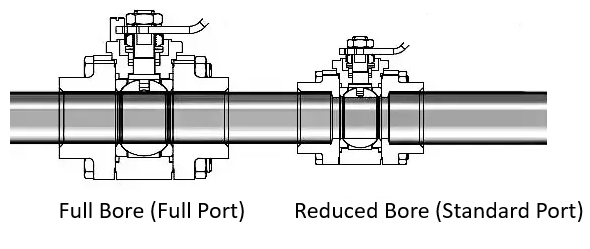
Full port ball valves are designed with a flow opening that remains approximately equal to the inside diameter of the connected pipe. Because the internal passage remains nearly unrestricted, fluid can move through the valve with minimal interruption to the flow path.
This design is commonly used in systems where maintaining consistent flow characteristics is important. By reducing restriction through the valve body, full port configurations can help lower pressure loss and reduce internal turbulence during operation.
Stainless steel full port ball valves are frequently installed in industrial processing systems, chemical transfer systems, compressed air headers, pump isolation lines, water handling equipment, and other fluid-control systems where unrestricted flow performance is preferred. Many of these applications are covered in our ball valve applications guide, including chemical processing, compressed air systems, water transfer, and industrial fluid-control systems.
What is a Standard Port Ball Valve?
A reduced port ball valve, often referred to as a standard port ball valve, is manufactured with a flow opening that is smaller than the inside diameter of the connected piping. When fluid passes through the valve, the flow path contracts within the valve body before expanding again after exiting the valve.
In many industrial valve applications, the terms standard port and reduced port are commonly used interchangeably. However, depending on the valve design and manufacturer, there can be a technical distinction between the two classifications.
A standard port ball valve generally uses an internal bore that is approximately one pipe size smaller than the connecting pipeline. A reduced port ball valve may use a greater reduction in internal bore size depending on the intended application and valve construction. Because of this, most standard port valves are considered reduced port valves, but not every reduced port valve is necessarily classified as a standard port design.
The smaller internal ball assembly allows standard port and reduced port valves to use a more compact body design, which can help reduce overall valve weight, material usage, and manufacturing cost when compared with full port configurations.
Although these valves create more restriction than full port designs, they remain widely used throughout industrial piping systems where reliable shut-off control is more important than maintaining unrestricted maximum flow capacity.
Reduced port and standard port ball valves are commonly installed in utility piping, equipment isolation systems, general industrial service lines, compact piping layouts, and applications where slight flow restriction is considered acceptable for the operating conditions. For a comparison of common valve body styles used with standard port designs, see our guide to 1 piece vs 2 piece ball valves.
➤ View Standard Port Ball Valves
Pressure Drop and Flow Restriction
The amount of restriction created inside a ball valve is determined largely by the size of the internal bore. Full port valves maintain a wider passage through the valve body, allowing liquids and gases to pass through with less disruption to system flow.
Reduced port, or standard port, valves narrow the flow area inside the valve, which can create a moderate increase in resistance and pressure drop compared to full port designs. In many industrial piping systems, however, this difference is small enough that it does not significantly affect normal shut-off service applications.
Systems that require improved flow efficiency, lower turbulence, or reduced pressure loss will often benefit from full port valves, while reduced port valves are frequently used where compact dimensions and cost efficiency are more important considerations. Valve pressure ratings should also be evaluated alongside flow characteristics. See our guide to ball valve pressure ratings.
When Not to Use a Reduced Port Ball Valve
A reduced port ball valve may not be the best choice when the system requires maximum flow capacity, very low pressure drop, or unrestricted access through the valve body. Applications involving high-flow transfer lines, process piping with strict flow requirements, or systems where internal restriction could affect performance are usually better suited to full port ball valves.
Reduced port and standard port valves are still highly effective for general shut-off service, but they should be selected carefully when flow efficiency is a major design requirement.
Common Applications
Full Port Ball Valve Applications
- ● Industrial process piping
- ● Chemical processing systems
- ● Water-transfer systems
- ● Compressed air systems and headers
- ● Pump isolation lines
- ● Applications requiring minimal pressure drop
- ● Pipeline systems requiring unrestricted flow
Standard Port Ball Valve Applications
- ● General shut-off service
- ● Compact piping systems
- ● Cost-sensitive applications
- ● Industrial utility systems
- ● Equipment isolation
- ● Applications where slight flow restriction is acceptable
Which Ball Valve Should You Choose?
Selecting between a full port and reduced port ball valve depends on the operating conditions of the system and the required flow performance. Full port valves are typically preferred when preserving pipeline flow capacity and minimizing restriction through the valve are important.
Reduced port, or standard port, valves are commonly used in applications where reliable shut-off control is required but slight flow reduction is acceptable. Their smaller internal components and more compact body design can also help reduce installation space requirements and overall valve cost.
Flow rate requirements, system pressure, piping layout, available installation space, and overall application demands should all be evaluated when determining which stainless steel ball valve design is most appropriate. When comparing a full port ball valve vs. a standard port ball valve, the main considerations are usually flow efficiency, acceptable pressure drop, installation space, and overall system cost. Material selection can also influence long-term performance. Compare corrosion resistance and chemical compatibility in our guide to 304 vs 316 stainless steel ball valves.
Frequently Asked Questions
What is the difference between full port and reduced port ball valves?
Full port ball valves have a larger opening through the valve ball, while reduced port ball valves use a smaller opening that narrows the flow path. Reduced port valves are also commonly called standard port ball valves.
Is a standard port ball valve the same as a reduced port ball valve?
In many industrial valve descriptions, standard port and reduced port refer to the same general design: a valve with a smaller internal bore than the connected pipe size.
Do reduced port ball valves reduce flow?
Yes. A reduced port ball valve can reduce flow slightly because the internal bore is smaller than the connected pipe size.
Are full port ball valves better?
Full port ball valves are better when maximum flow and lower pressure drop are important. Reduced port or standard port valves may be better when compact size and lower cost are the main priorities.
Where are full port ball valves used?
Full port ball valves are commonly used in industrial processing, chemical systems, water-transfer lines, compressed air systems, pump isolation lines, and applications where unrestricted flow is preferred.
Where are standard port ball valves used?
Reduced port ball valves are commonly used for general shut-off service, utility piping, compact systems, equipment isolation, and applications where slight flow restriction is acceptable.
Related Ball Valve Resources
➤ What is a Ball Valve?
Learn how ball valves work, how quarter-turn shut-off valves operate, common valve types, and typical industrial applications.
➤ Ball Valve Applications
Learn how stainless steel ball valves are used in water systems, oil and gas piping, chemical processing, compressed air systems, food processing, hydraulic systems, and industrial fluid control.
➤ Ball Valve Pressure Ratings Explained
Understand WOG meaning, PSI ratings, pressure-temperature derating, and how pressure conditions affect valve selection.
➤ 304 vs 316 Stainless Steel Ball Valves
Compare corrosion resistance, chemical compatibility, marine performance, and how stainless steel grade affects valve selection.
➤ Ball Valve Parts and Components
Learn how valve bodies, balls, PTFE seats, stems, seals, packing, handles, and threaded end connections function in industrial ball valves.
➤ How to Install a Threaded Ball Valve
Review NPT thread preparation, PTFE tape use, tightening methods, valve orientation, and leak testing for threaded ball valve installations.
➤ 1 Piece vs 2 Piece Ball Valve
Compare valve body construction, reduced port vs full port flow design, compactness, maintenance access, and common industrial applications.
➤ 2 Piece vs 3 Piece Ball Valve
Learn the differences between 2 piece and 3 piece ball valves, including serviceability, maintenance access, and industrial valve selection.
Shop Stainless Steel Ball Valves
➤ Shop Standard Port Ball Valves
View reduced port stainless steel ball valves for compact installations, equipment isolation, utility piping, and general industrial shut-off applications.
➤ Shop Full Port Ball Valves
Browse full port stainless steel ball valves designed to maximize flow capacity while minimizing pressure drop and flow restriction.
➤ Browse Stainless Steel Ball Valves
Explore threaded stainless steel ball valves including full port, reduced port, 2-piece, and 3-piece designs for industrial fluid-control applications.
