
Stainless Steel 3 Way Ball Valves
| Size | 1/2" to 2" |
|---|---|
| Part Number | Threaded 3-Way Valve |
| Material | Stainless Steel 316 |
| Handles | Stainless Steel 304 |
| Temperature Rating | -13°F to 302°F |
| Seal | Teflon (PTFE) |
| Thread | Female NPT |
| Working Pressure | 1000 PSI |

Stainless Steel 3 Way Ball Valves – T-Port & L-Port
Threaded 3 way stainless steel ball valves are designed to divert, distribute, mix, or select flow between three piping connections. These valves are available in T-Port and L-Port configurations, allowing fluid to be routed between multiple lines using a single valve body instead of multiple two-way valves and tee fittings.
Manufactured from 316 stainless steel, these threaded 3 way ball valves provide corrosion resistance, durability, and dependable performance in water, oil, gas, and industrial fluid handling systems. Female NPT threaded connections allow installation into standard threaded piping systems, while the ISO mounting pad allows for actuator installation where automated operation is required.
➤ To understand the differences between T-Port and L-Port configurations, see our L-Port vs T-Port Ball Valve Guide.
➤ For all three-way valve configurations, view our 3 Way Ball Valves.
Advantages:
- ● Can divert, distribute, mix, or select flow using one valve body
- ● Available in T-Port and L-Port configurations for different flow-routing requirements
- ● Female NPT threaded ends allow installation into standard threaded piping systems
- ● ISO mounting pad supports actuator installation for automated operation
- ● 316 stainless steel construction provides corrosion resistance and durability
Consideration: These valves use a reduced port design, meaning the internal bore is smaller than the nominal pipe size.
Key Features:
- ● Suitable Media: Water, Oil, and Gas (WOG)
- ● Threads: Female NPT threaded ends
- ● Port: Reduced port design
- ● Configurations: T-Port and L-Port flow patterns
- ● Seats and Seals: PTFE (Teflon)
- ● Operation: Quarter-turn manual handle
- ● Handle: Lever handle with removable locking device
- ● Mounting: ISO mounting pad for actuator installation
- ● Pressure Rating: 1000 WOG / 1000 PSI (6.4 MPa)
- ● Temperature Range: -13°F to 302°F
- ● Body Material: Stainless steel 316
T-Port vs L-Port 3 Way Ball Valves
Threaded 3 way ball valves are available in two main flow configurations: T-Port and L-Port. The correct choice depends on whether the system requires mixing, splitting, diverting, source selection, or shut-off capability.
T-Port 3 Way Ball Valves are commonly used for mixing, splitting, combining, or distributing flow between multiple process lines. A T-Port valve can connect all three ports at once or connect selected pairs of ports depending on handle position.
L-Port 3 Way Ball Valves are commonly used for diverting flow between two different piping routes or selecting between two fluid sources. An L-Port valve connects two ports at a time and can be configured to shut off flow.

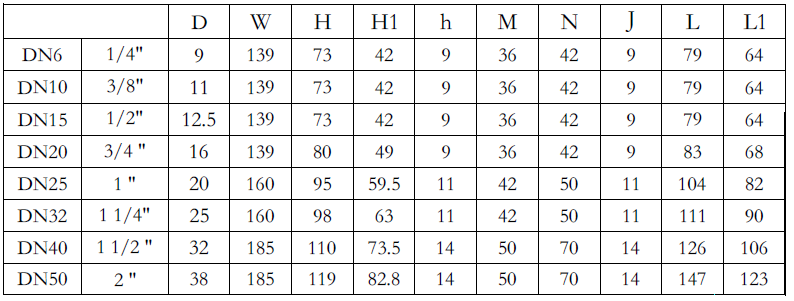
3 Way Ball Valve Dimensions
Threaded 3 way ball valves are built with a three-port body and threaded end connections. Because the internal ball must accommodate multiple flow paths, these valves use a reduced port design rather than a full port bore.
- ● Three-port body design allows multiple flow-routing positions.
- ● Reduced port construction helps accommodate the T-Port or L-Port internal ball design.
- ● Female NPT threaded ends allow connection to standard threaded piping systems.
➤ Learn how bore size affects flow capacity and pressure drop in our Full Port Ball Valve vs Standard Port guide.

3 Way Ball Valve Material List
Material composition details are provided below and may vary slightly by valve size and configuration.
- ● Wetted components are manufactured from 316 stainless steel for corrosion resistance.
- ● Seats and seals are made from PTFE (Teflon) for chemical resistance and sealing performance.
- ● Stainless steel construction makes these valves suitable for demanding industrial fluid systems.

What is a Threaded 3 Way Ball Valve?
A threaded 3 way ball valve is a multi-port valve with three female NPT threaded connections and an internal ball designed to route flow between multiple ports. Unlike a standard two-way ball valve, which only opens or closes flow through one straight path, a 3 way valve can divert, distribute, mix, or select flow paths depending on the internal port pattern and handle position.
These valves are commonly used in industrial piping systems where flow needs to be directed between multiple lines without using separate valves and tee fittings.
Why Choose Threaded 3 Way Ball Valves
Threaded 3 way ball valves are selected when a system requires flexible flow routing in a compact valve body. They can simplify piping layouts by replacing multiple valves and fittings with a single multi-port valve.
- Useful for flow diversion, mixing, splitting, and source selection
- Reduces the need for multiple valves and tee fittings
- Available in T-Port and L-Port configurations
- Threaded NPT ends allow practical installation and removal
- Suitable for water, oil, gas, and industrial fluid handling systems
When to Choose Threaded 3 Way Ball Valves
Threaded 3 way ball valves are best suited for systems where flow must be routed between multiple lines. The correct configuration depends on whether the valve is being used for mixing, diverting, distributing, or selecting between sources.
- Applications requiring flow diversion between two outlets
- Systems requiring mixing or combining of two flow streams
- Installations where one valve can replace multiple valves and fittings
- Industrial piping systems using female NPT threaded connections
- Applications requiring optional actuator mounting
Common Applications
- Water treatment systems
- Industrial process piping
- Chemical-compatible fluid handling
- Fluid transfer and routing systems
- Mixing and distribution applications
- Equipment and OEM installations
➤ For additional examples of industrial uses and valve selection guidance, see our Ball Valve Applications guide.
Frequently Asked Questions About Stainless Steel 3 Way Ball Valves
What is a threaded 3 way ball valve used for?
A threaded 3 way ball valve is used to divert, distribute, mix, or select flow between three piping connections. It is commonly used in industrial systems where fluid needs to be routed between multiple lines.
What is the difference between T-Port and L-Port 3 way ball valves?
A T-Port 3 way ball valve can connect all three ports or selected pairs of ports, making it suitable for mixing, splitting, and distribution. An L-Port 3 way ball valve connects two ports at a time and is commonly used for diverting flow or selecting between sources.
Can a 3 way ball valve shut off flow?
An L-Port 3 way ball valve can be configured to shut off flow. A T-Port 3 way ball valve is generally used for mixing, distribution, or flow routing and typically cannot shut off all flow paths at once.
Are threaded 3 way ball valves full port?
No. These threaded 3 way ball valves use a reduced port design because the internal ball must accommodate multiple flow paths for T-Port or L-Port operation.
What connection type do these valves use?
These valves use female NPT threaded connections, making them compatible with standard threaded industrial piping systems.
What material are these 3 way ball valves made from?
These valves are manufactured from 316 stainless steel with PTFE seats and seals for corrosion resistance, chemical resistance, and dependable sealing performance.
What pressure rating do these valves have?
These threaded 3 way ball valves are rated to 1000 WOG / 1000 PSI for water, oil, gas, and general industrial service under normal operating conditions.
Related Ball Valve Resources
➤ L-Port vs T-Port Ball Valve
Compare flow paths, mixing capabilities, diverting functions, and common applications of T-Port and L-Port 3 way ball valves.
➤ Full Port Ball Valve vs Standard Port
Compare bore size, pressure drop, flow restriction, and common industrial applications.
➤ Ball Valve Applications
Learn how stainless steel ball valves are used in water treatment, industrial processing, chemical handling, and fluid transfer systems.
➤ Ball Valve Pressure Ratings Explained
Understand WOG ratings, PSI ratings, pressure-temperature relationships, and pressure derating.
Other Stainless Steel Ball Valve Types
In addition to threaded 3 way ball valves, stainless steel ball valves are available in several body styles and configurations depending on flow requirements, maintenance needs, and application type.
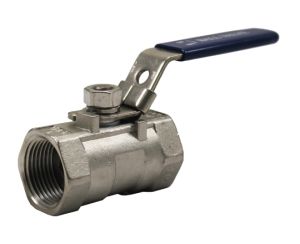
- 1 Piece Ball Valves – compact reduced-port valves for general shut-off applications.
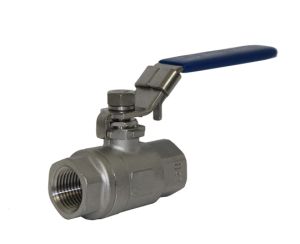
- 2 Piece Ball Valves – full port valves for standard industrial shut-off applications.
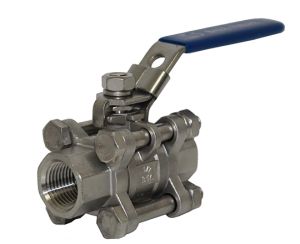
- 3 Piece Ball Valves – serviceable valves designed for inline maintenance and cleaning.
Specifications:
| Size | 1/2" to 2" |
|---|---|
| Part Number | Threaded 3-Way Valve |
| Material | Stainless Steel 316 |
| Handles | Stainless Steel 304 |
| Temperature Rating | -13°F to 302°F |
| Seal | Teflon (PTFE) |
| Thread | Female NPT |
| Working Pressure | 1000 PSI |