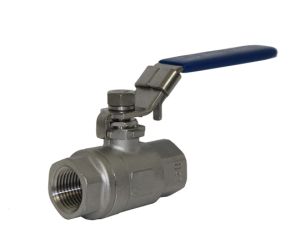
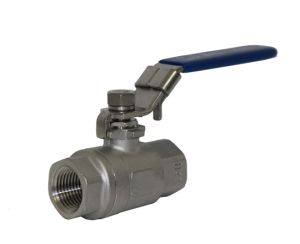
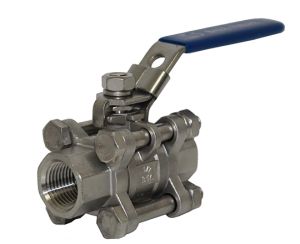
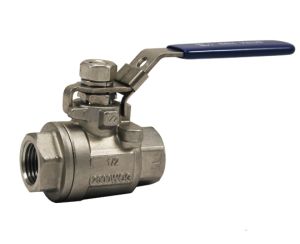
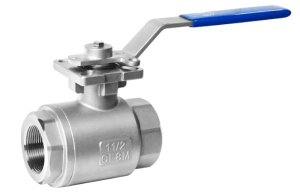
2 Piece Full Port Ball Valves - 316 Stainless Steel
| Size | 1/4" to 4" |
|---|---|
| Part Number | (316) Ball Valves |
| Material | Stainless Steel 316 |
| Handles | Stainless Steel 304 |
| Temperature Rating | -13⁰F to 302⁰F |
| Seal | Teflon (PTFE) |
| Thread | Female NPT |
| Working Pressure | 1000 PSI |
 View 304 Stainless Steel 2 Piece Full Port Ball Valves
View all 2 Piece Full Port Ball Valves
Two Piece Full Port Ball Valves - 316 Stainless Steel
Two piece full port threaded ball valves in 316 stainless steel are available in sizes from 1/4" to 4", making them suitable for both small equipment connections and larger piping systems. Manufactured from 316 stainless steel, these valves provide reliable shut-off control while maintaining efficient, unrestricted flow through the system. Featuring female NPT threaded connections, these valves are designed for easy installation and use with standard piping systems. They are commonly used in applications requiring enhanced corrosion resistance, durability, and consistent flow. These threaded ball valves are designed to provide improved corrosion resistance and dependable performance in more demanding service conditions. The full port (full bore) design allows fluid to pass through with minimal restriction, while the 1000 WOG pressure rating ensures suitability for water, oil, and gas applications.
For general-purpose applications where corrosion exposure is limited, see our 304 stainless steel 2 piece ball valves.
Advantages:
- ● More resistant to corrosion than 304 stainless steel in demanding environments
- ● Two-piece construction allows access for maintenance and seat replacement
- ● Full port design allows uninterrupted maximum flow
- ● Suitable for applications involving moisture, chemicals, or corrosive media
Features:
Key specifications and performance features of 2-piece stainless steel ball valves include:
- ● Suitable Media: Water, oil, and gas (WOG)
- ● Threads: Female NPT threaded ends for standard piping connections
- ● Seats and Seals: PTFE (Teflon) for chemical resistance and smooth operation
- ● Port: Full port (full bore) design supports consistent flow and reduces restriction through the valve
- ● Handle: Lever-operated with locking capability in open or closed position
- ● Operation: Quarter-turn action for fast and reliable shut-off control
- ● Stem: Blow-out proof design for added safety
- ● Pressure Rating: 1000 WOG (1000 PSI / 6.4 MPa) at ambient temperature
- ● Temperature Range: -4°F to 302°F (-20°C to 150°C)
- ● Body Material: Stainless steel 316 (CF8M)
- ● Non-Wetted Components: 316 stainless steel
Two Piece Ball Valve Dimensions
- ● Since it is made from two body parts, it can be opened for servicing and cleaning.
- ● It is a full port ball valve, which means the internal diameter (ID) of the pipe remains constant throughout the length of the valve body.
- ● 316 stainless steel is more corrosion resistant than 304, making this a suitable choice for chemical-resistant applications.

Two Piece Ball Valve Material Components
- ● Manufactured from 316 stainless steel for greater corrosion resistance.
- ● PTFE (Teflon) seals provide chemical resistance as well as heat resistance.

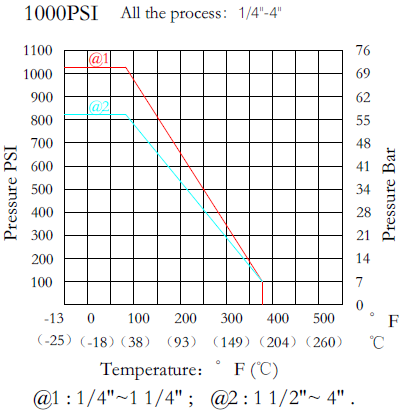
Two Piece Ball Valve Pressure Chart
● Pressure ratings are based on operating temperatures; refer to the chart below.
Why Choose 316 Stainless Steel Ball Valves
316 stainless steel ball valves are designed for applications where higher levels of corrosion resistance are required. The addition of molybdenum in 316 stainless steel improves its ability to withstand exposure to chemicals, chlorides, and moisture, making it well suited for more aggressive service conditions.
These valves are commonly used in environments where standard stainless steel may not provide sufficient protection over time. Their durability and resistance to corrosion help maintain consistent performance while reducing the need for frequent maintenance or replacement.
- Improved corrosion resistance over 304 stainless steel
- Well suited for chemical processing and washdown environments
- Performs reliably in high-moisture or outdoor conditions
- Designed for long-term use in more demanding applications
When to Choose 316 Stainless Steel Ball Valves
316 stainless steel ball valves are typically selected when the application involves more demanding service conditions where standard materials may not perform as reliably over time. They are especially well suited for systems exposed to moisture, chemicals, or environments where corrosion is a concern.
These valves are commonly used in installations where long-term durability and reduced maintenance are important. Choosing 316 stainless steel helps ensure consistent performance in systems that operate under harsher conditions or require a higher level of material protection.
- Applications involving chemical exposure or aggressive media
- Marine, coastal, or high-humidity environments
- Outdoor installations where corrosion resistance is important
- Systems requiring long service life with minimal maintenance
Common Applications
- Chemical processing and handling systems
- Marine and offshore equipment
- Water treatment and washdown environments
- Industrial systems exposed to moisture or corrosive conditions
- Equipment, machinery, and OEM installations
Industries
- Chemical processing and manufacturing
- Marine and coastal operations
- Food processing and sanitation systems
- Water treatment and utilities
- General industrial applications requiring corrosion resistance
316 vs 304 Stainless Steel Ball Valves
316 and 304 stainless steel ball valves are designed for different operating conditions. While both materials offer durability and corrosion resistance, 316 stainless steel provides improved performance in environments where exposure to moisture, chemicals, or corrosive elements is more likely.
Choosing between these materials depends on the application, operating environment, and level of corrosion resistance required for long-term performance.
| Comparison | 316 Stainless Steel | 304 Stainless Steel |
|---|---|---|
| Corrosion Resistance | Better suited for environments with chemicals, chlorides, or moisture | Performs well in general environments with limited corrosive exposure |
| Chemical Resistance | More resistant to aggressive media and chemical exposure | Best suited for water, air, and mild fluids |
| Material Composition | Contains molybdenum for improved corrosion resistance | Standard stainless steel composition without molybdenum |
| Performance in Harsh Conditions | Maintains performance in marine, chemical, and high-moisture environments | More suitable for controlled or less aggressive conditions |
| Cost | Higher cost due to enhanced material properties | More economical for standard applications |
| Typical Applications | Chemical processing, marine, and corrosive environments | General industrial, water, and air systems |
In applications where corrosion resistance and long-term durability are important, 316 stainless steel is often the preferred option. For general-purpose systems where exposure to corrosive elements is limited, 304 stainless steel remains a reliable and cost-effective choice.
Frequently Asked Questions
Where are 316 stainless steel ball valves most commonly used?
316 stainless steel ball valves are commonly installed in systems where exposure to moisture, chemicals, or corrosive elements is expected. They are frequently used in marine environments, washdown areas, and industrial applications where long-term material performance is important.
Can 316 stainless steel ball valves be used with chemicals?
316 stainless steel is well suited for use in systems where exposure to chemicals is a concern, thanks to its improved resistance to corrosion. It is often chosen for systems handling more aggressive media, although material compatibility should always be confirmed for the specific fluid being used.
Are 316 stainless steel ball valves full port?
Yes, these valves are designed with a full port (full bore), allowing fluid to pass through with minimal restriction and helping maintain consistent flow throughout the system.
How does 316 stainless steel compare to 304 for ball valves?
316 stainless steel provides greater protection against corrosion than 304, especially in environments where moisture, chemicals, or chlorides are present. While 304 is suitable for general use, 316 is typically chosen for more demanding conditions.
Are 316 stainless steel ball valves suitable for outdoor use?
Yes, 316 stainless steel is commonly used for outdoor installations, particularly in environments with high humidity, salt exposure, or changing weather conditions where additional corrosion resistance is required.
What pressure rating do these 316 stainless steel ball valves have?
These valves are rated to 1000 WOG, making them suitable for use with water, oil, and gas within that pressure range under standard operating conditions.
Types of Stainless Steel Ball Valves
Stainless steel ball valves are available in several body styles, each designed for different installation, maintenance, and flow requirements:
- 1 Piece Ball Valves – compact, single-body design typically used for reduced port applications.
- 2 Piece Ball Valves – full port valves offering a balance of performance, cost, and serviceability.
- 3 Piece Ball Valves – designed for easy maintenance without removing the valve from the pipeline.
Specifications:
| Size | 1/4" to 4" |
|---|---|
| Part Number | (316) Ball Valves |
| Material | Stainless Steel 316 |
| Handles | Stainless Steel 304 |
| Temperature Rating | -13⁰F to 302⁰F |
| Seal | Teflon (PTFE) |
| Thread | Female NPT |
| Working Pressure | 1000 PSI |